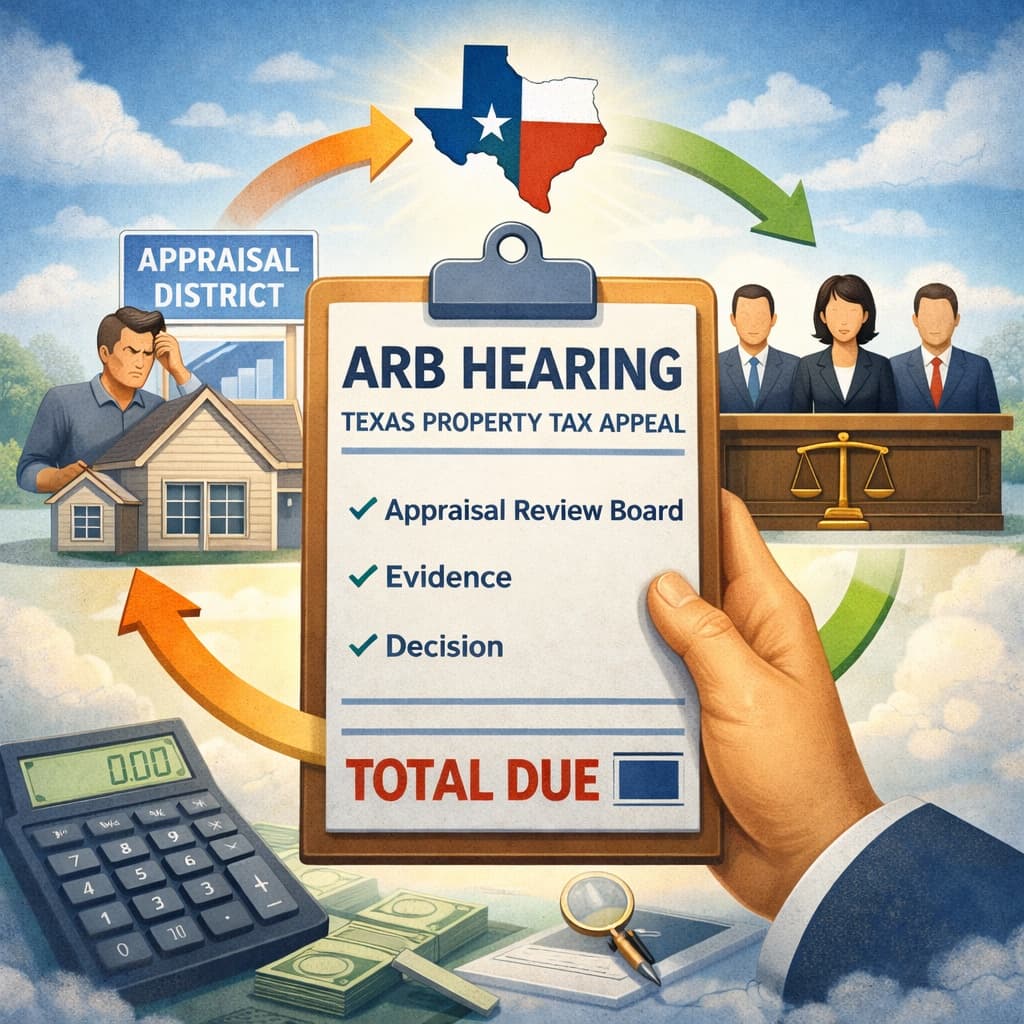
What Happens at a Texas ARB Hearing?
At an ARB hearing, you present evidence to a panel of citizens (the Appraisal Review Board) who decide whether to lower your property's assessed value. The hearing typically lasts 15-30 minutes and follows this process:
- Check in at the hearing location or log into the virtual hearing
- Present your case with comparable sales, photos, or other evidence
- Appraisal district responds with their supporting evidence
- Panel asks questions to clarify both sides
- Receive a decision (immediately or by mail within days)
The ARB is independent from the appraisal district, and their decision is binding unless you file a further appeal.
What Is an ARB Hearing?
ARB stands for Appraisal Review Board. Every Texas county has an ARB that hears property tax protests when homeowners and appraisal districts can't reach agreement during the informal review stage.
The ARB hearing is your opportunity to:
- Present evidence supporting a lower property value
- Challenge the appraisal district's valuation methodology
- Receive a binding decision on your property's assessed value
ARB hearings are more formal than informal reviews but are designed to be accessible to homeowners representing themselves.
Informal Review vs. ARB Hearing
Every protest is entitled to both steps. You don't have to choose: if the informal review doesn't produce an acceptable offer, your case moves to the ARB.
| Factor | Informal review | ARB hearing |
|---|---|---|
| Who decides | Appraisal district staff | Independent panel of the Appraisal Review Board |
| Format | Negotiation, no sworn testimony | Formal hearing with sworn testimony |
| Typical length | About 15 minutes | About 15 minutes, longer for complex cases |
| Outcome | A settlement you can accept or decline | A binding order on your value |
| Next step | Decline and go to the ARB | Arbitration, SOAH or district court |
Accept an informal offer when it brings your value in line with your evidence, or when the remaining gap is small compared with the time a hearing takes. Go to the ARB when the appraiser won't move, the offer ignores strong comparable sales or condition evidence, or you have an unequal appraisal argument the district dismissed.
Ways to attend: most districts offer in-person, telephone and video hearings, and you can submit your evidence by sworn affidavit if you can't attend. Under Texas Tax Code Section 41.45(b-4), you can also request a single-member panel instead of the usual three members by asking in writing at least 10 days before your hearing.
The ARB Hearing Process (Step-by-Step)
1. Receive Your Hearing Notice
After filing a protest and completing (or skipping) the informal review, you'll receive a notice with:
- Your hearing date and time
- Location or virtual hearing instructions
- Deadline to submit evidence
- Instructions for requesting postponements
Most counties provide 15-45 days notice before your hearing date.
2. Submit Your Evidence
You must exchange evidence with the appraisal district before the hearing. Key deadlines:
- 14 days before hearing: Appraisal district must provide their evidence packet
- 7 days before hearing (varies by county): You should submit your evidence
Evidence you can submit includes:
- Comparable sales data
- Photos of property condition issues
- Repair estimates
- Unequal appraisal analysis
- Purchase contract (if recently bought)
What to Do When You Receive the Appraisal District's Evidence Packet
Under Texas Tax Code Section 41.67, the appraisal district must send you their evidence at least 14 days before your hearing. When it arrives:
- Check their comparable sales - Are the comps truly similar to your property in size, age, condition, and location? Flag any that are significantly different.
- Look for errors - Verify they have the correct square footage, lot size, year built, and property features for your home.
- Identify weaknesses - If their comps sold for less than your appraised value, that actually supports your case. Note any comps that help you.
- Prepare rebuttals - For each comp they use that you disagree with, be ready to explain why it is not comparable (different neighborhood, larger lot, renovated, etc.).
Having a response ready for the district's evidence is just as important as preparing your own.
3. Check In at the Hearing
On your hearing day:
- Arrive 15-30 minutes early
- Check in with ARB staff
- Review your evidence packet
- Wait to be called
For virtual hearings, log in early and test your audio/video.
4. Present Your Case
When called, you'll have a set time (typically 15-20 minutes total) to:
- State your position: What value you believe is correct and why
- Present evidence: Walk through your comparable sales or other evidence
- Respond to the appraisal district: They'll present their case
- Answer questions: ARB panel members may ask clarifying questions
The appraisal district representative will also present their evidence supporting the current assessed value.
5. Receive the Decision
The ARB panel will either:
- Deliberate immediately and announce a decision
- Take the case under advisement and mail the decision
You'll receive a written order stating the final determined value. This decision is binding unless you file a further appeal to district court or binding arbitration.
How to Prepare for Your ARB Hearing
Organize Your Evidence
- Lead with your strongest evidence (usually comparable sales)
- Number your exhibits for easy reference
- Bring copies for each panel member (typically 3-5 copies)
- Practice your presentation to fit within time limits
Know Your Arguments
The two most effective arguments in Texas:
- Market Value: Your home's value is less than the appraised amount based on recent comparable sales
- Unequal Appraisal: Your home is appraised higher than similar properties in your area
You can argue both. Many successful protests use unequal appraisal evidence when comparable sales are scarce.
Understand What Works (and What Doesn't)
Effective evidence:
- Recent sales of similar homes at lower prices
- Assessed values of comparable properties (for unequal appraisal)
- Photos and estimates for property condition issues
- Professional appraisals
Ineffective arguments:
- "My taxes are too high" (ARB only determines value, not tax rates)
- "I can't afford this" (financial hardship isn't grounds for reduction)
- "The county wastes money" (not relevant to property value)
- Zillow estimates or online valuations
Consider Representation
You can:
- Represent yourself - Many homeowners do this successfully
- Hire a property tax consultant - They handle everything
- Hire an attorney - Typically only for complex cases
At Ballard Property Tax Protest, we attend ARB hearings on your behalf at no additional cost. You don't need to take time off work or prepare evidence yourself.
ARB Hearing Tips That Work
Be Professional and Concise
- Address the panel respectfully
- Stick to facts and evidence
- Don't argue with the appraisal district representative
- Thank the panel for their time
Focus on Value, Not Taxes
The ARB determines property value only. Tax rates are set by taxing entities (city, county, school district) and aren't subject to protest.
Use Local Data
Evidence from your neighborhood carries more weight than distant comparisons. The closer your comps are geographically, the stronger your case.
Don't Accept a Bad Offer
If the appraisal district offers a settlement before or during the hearing that doesn't meet your expectations, you can decline and proceed with the full hearing.
What Happens After the ARB Hearing?
If You Win
Your assessed value is reduced to the amount determined by the ARB. Your tax bill will be calculated using this lower value.
If You Lose (or Want a Further Reduction)
You have additional options:
- Binding Arbitration: For properties under $5 million, you can request binding arbitration within 60 days. Filing fee is $500-$1,550 depending on value.
- District Court Appeal: You can sue the appraisal district in district court within 60 days.
- State Office of Administrative Hearings (SOAH): For cases involving appraised values over $1 million, you can appeal to SOAH instead of district court. SOAH uses an administrative law judge rather than a jury, and the process is generally faster and less expensive than a full district court lawsuit. Notice of the appeal is due within 30 days after you receive the ARB's order.
Most residential homeowners don't pursue further appeals, but the option exists for significant disputes.
County-Specific ARB Information
Each Texas appraisal district runs its informal reviews and ARB hearings a little differently.
Harris County (HCAD)
- iFile for filing your protest online and iSettle for reviewing and accepting settlement offers online, with offers sent by email
- Submit evidence within 5 days of filing (by midnight of the fifth calendar day) so HCAD reviews it before your informal review
- Informal reviews and hearings are available in person, by phone or by video
- Roughly 89% of informal protests in Harris County result in a value reduction
- HCAD handles the largest protest volume in Texas, so file early
See how to file your HCAD protest online and our Harris County protest services.
Dallas County (DCAD)
- Your case moves to the ARB queue automatically if the informal review doesn't settle it
- DCAD sends an ARB hearing notice at least 15 days before your hearing, electronically if you're enrolled in its Electronic Notification System
- Telephone hearings are the default for most protests. Request an in-person hearing on your protest form if you prefer one, and Saturday hearings are offered on several dates in June and July on request
- Hearings typically start in early May, most finish by mid-July, and larger protests continue into September
- In 2024, about 84% of informal protests and 67% of ARB hearings produced a reduction, saving Dallas County owners about $349 million (informal) and $579 million (ARB) in taxes
See our Dallas County property tax protest guide.
Williamson County (WCAD)
- WCAD schedules your informal review and ARB hearing on the same day: you meet with an appraiser first, and if you don't agree, you go straight to the ARB. Come prepared for both
- Hearings run April through July, Monday through Thursday, 8 a.m. to 5 p.m., with notices mailed at least 15 days ahead
- Video hearings use RingCentral. Telephone hearings must be requested in writing at least 10 days before your hearing date
- If you can't attend, submit a notarized affidavit to Affidavits@wcad.org
- Request WCAD's evidence at least 14 days before your hearing
- In 2024, owners protested 85,030 accounts (31% of properties). About 54% of informal reviews and 55% of ARB hearings produced reductions
See our Williamson County protest services.
Other Counties
- Montgomery County ARB process
- Travis County (TCAD) informal review vs ARB hearing
- Harris County ARB hearing tips
Frequently Asked Questions
Can I skip the informal review and go straight to ARB?
Yes. The informal review is optional. However, most protests settle at the informal stage, so it's usually worth attempting.
What if I can't attend my scheduled hearing?
You can request a postponement (usually once, sometimes twice). Contact the ARB office before your hearing date.
Can I bring a witness to my ARB hearing?
Yes. You can bring witnesses, but they must provide relevant testimony about your property's value or condition.
How long does an ARB hearing take?
Most residential hearings take 15-30 minutes total, including both your presentation and the appraisal district's response.
Is the ARB decision final?
The ARB decision is final unless you file for binding arbitration or district court appeal within 60 days.
Let Us Handle Your ARB Hearing
Preparing for and attending an ARB hearing takes time and expertise. At Ballard Property Tax Protest:
- We prepare professional evidence packets with comparable sales and unequal appraisal analysis
- We attend all hearings on your behalf - you don't need to be there
- We know what works in each county's ARB process
- You only pay if we reduce your value - no reduction, no fee
Sign up for your Texas property tax protest and let us handle the ARB hearing process from start to finish.
Sources
- Texas Tax Code - Section 41.67: Hearing Procedures
- Texas Tax Code - Section 41.45: Notice of Protest
- Texas Comptroller - Appraisal Protests and Appeals
- Texas Tax Code - Section 41A.01: Right of Appeal by Property Owner (Binding Arbitration)
- Texas Tax Code - Section 42.01: Right of Appeal to District Court