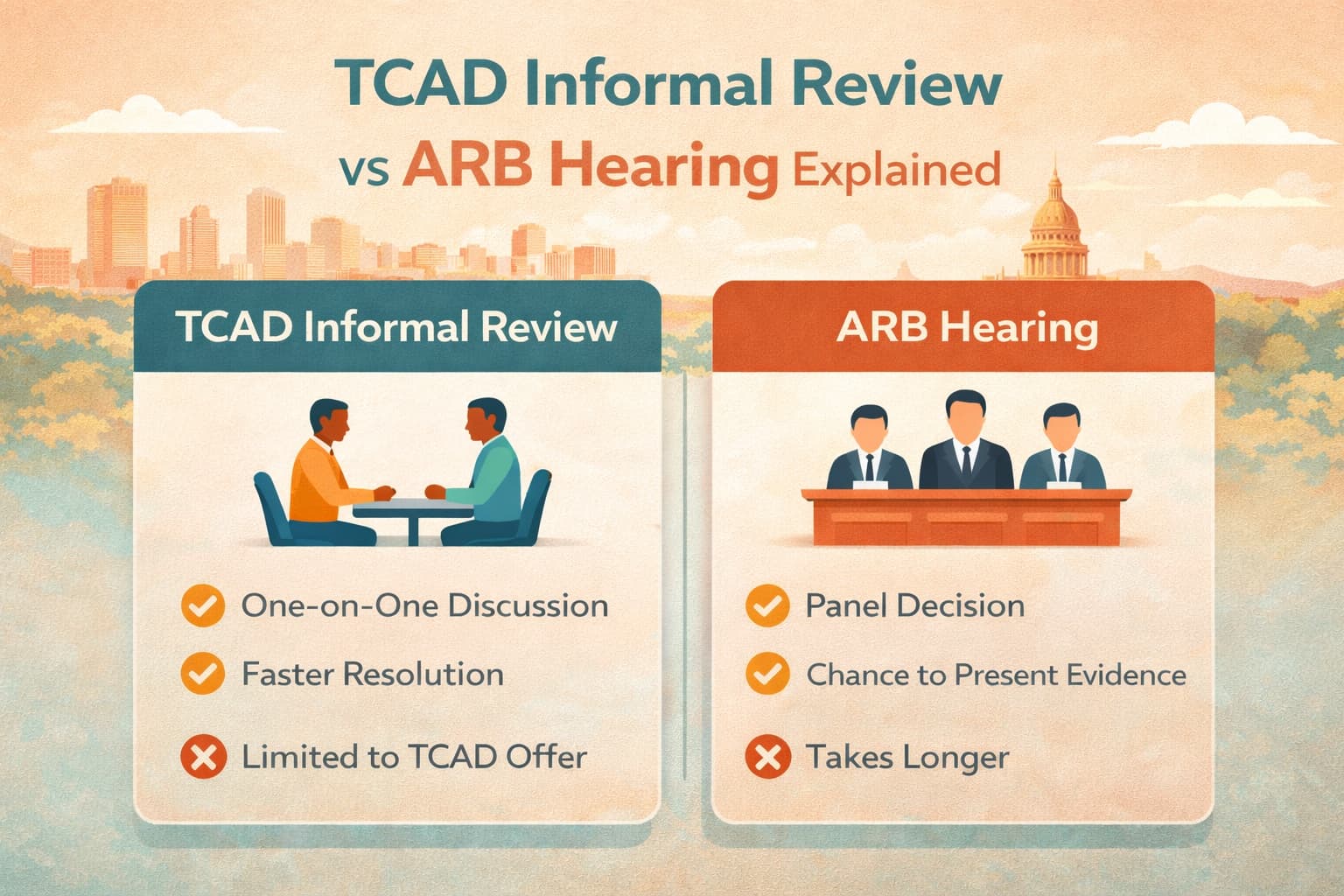
TCAD Informal Review vs ARB Hearing Explained
When you file a property tax protest in Travis County, you have two opportunities to challenge your assessed value: the TCAD informal review and the Appraisal Review Board (ARB) hearing. Understanding the difference between these two processes can help you choose the right strategy for your situation and maximize your chances of a successful outcome.
Here are the details:
- How the TCAD informal review process works
- How ARB hearings work in Travis County
- Key differences between the two approaches
- Pros and cons of each option
- When to accept informal settlement vs proceed to ARB
- Success rates and winning strategies
For a complete overview of the protest process, see our Travis County property tax protest guide.
What Is a TCAD Informal Review?
An informal review is a negotiation-style meeting with TCAD appraisal staff that occurs before any formal hearing. It's your first opportunity to resolve your protest without going to the Appraisal Review Board.
How it works:
- After filing your protest, you become eligible for an informal meeting
- You schedule your meeting through the TCAD online portal or get in line online
- You meet with a TCAD appraiser (by phone or videoconference)
- Both parties discuss the property value and your evidence
- TCAD may make a settlement offer based on your evidence
- If you accept, your protest is resolved
- If you decline, your case proceeds to the ARB
Key characteristics:
- Less formal than ARB hearings
- Conducted by TCAD staff (not independent board members)
- Negotiation-focused
- No sworn testimony required
- Can result in quick resolution
- Only one informal meeting allowed per property
In Travis County, the informal process typically begins in mid-April each year. In 2025, informal meetings started April 14, giving property owners several weeks to negotiate before ARB hearings begin in June.
How to Schedule Your TCAD Informal Meeting
Travis County offers multiple ways to participate in informal meetings:
Online Portal Scheduling
Property owners with a TCAD online portal account can:
- Schedule an informal meeting for a specific date and time
- Check in for their meeting at the scheduled time
- Cancel or reschedule meetings as needed
Get in Line Online
Property owners who don't have a portal account or prefer not to schedule a specific time can use TCAD's "Get in Line Online" system to join the day's queue.
Before Your Informal Meeting
Critical steps to complete first:
- File your protest before getting in line (deadline: May 15 or 30 days after your Notice is mailed)
- Submit your evidence through the online portal (estimated processing time: 2 hours)
- Review TCAD's evidence available in the portal
Evidence submitted early gives TCAD time to review your case before the meeting, improving your chances of receiving a fair settlement offer.
What Is a Travis County ARB Hearing?
The Travis Appraisal Review Board (ARB) is an independent group of citizens authorized to resolve disputes between property owners and TCAD. If your informal review doesn't result in an acceptable settlement, your case goes to the ARB.
How it works:
- You receive at least 15 days notice before your hearing
- You attend in person, by phone, or by video conference
- The ARB panel of three citizens hears your case
- Both you and TCAD present evidence and arguments
- Panel members may ask questions
- The ARB panel makes a binding determination
- You receive a Notice of Final Order within 3-4 weeks
Key characteristics:
- Formal hearing with independent board members
- ARB has no role in TCAD's day-to-day operations or appraisals
- Three-person panels hear testimony and review evidence
- Board must base decisions on facts presented
- Both parties present arguments
- Creates record for potential appeal
- Hearings typically last 15-20 minutes
In Travis County, ARB hearings run from June through August each year.
Side-by-Side Comparison
| Factor | Informal Review | ARB Hearing |
|---|---|---|
| Who decides | TCAD appraisal staff | Independent ARB panel (3 citizens) |
| Formality | Casual, negotiation-style | Formal hearing |
| Timeline | April-May | June-August |
| Meeting length | 10-15 minutes | 15-20 minutes |
| Attendance | Phone or videoconference | In-person, phone, video, or affidavit |
| Evidence rules | Flexible | Bring 5 copies to hearing |
| Outcome | Settlement offer | Binding determination |
| Appeal option | Proceed to ARB | Appeal to binding arbitration or District Court |
| Best for | Clear-cut cases | Disputed or complex valuations |
Travis County Protest Success Rates
Understanding success rates helps you decide whether to accept a settlement or proceed to the ARB.
2024 Travis County Statistics
| Stage | Success Rate |
|---|---|
| Informal protests | 87% |
| Formal ARB protests | 89% |
Financial Impact
| Year | Total Savings |
|---|---|
| 2023 | $531 million |
| 2024 | $655 million |
These high success rates demonstrate that both informal reviews and ARB hearings can produce meaningful reductions. The key is presenting strong evidence at either stage.
Pros and Cons of TCAD Informal Review
Pros:
- Faster resolution (April-May vs June-August)
- Less adversarial atmosphere
- Direct negotiation with appraiser who understands your valuation
- Good for cases with clear evidence
- Convenient phone or video format
- Many cases resolve without formal hearing
- Less preparation required
Cons:
- TCAD staff may not offer significant reductions without strong evidence
- Less formal protection if TCAD is unreasonable
- Settlement depends on TCAD's willingness to negotiate
- No independent review of TCAD's methodology
- Only one meeting allowed per property
- Settlement offers may expire if not accepted before ARB hearing
Pros and Cons of ARB Hearing
Pros:
- Independent third-party review
- Board members not incentivized to defend TCAD's value
- Better for challenging TCAD's methodology
- Formal legal protections
- Creates record for appeal if necessary
- Strong for unequal appraisal claims
- Multiple attendance options (in-person, phone, video, affidavit)
Cons:
- More time-consuming process (hearings run June-August)
- More formal and potentially intimidating
- Requires prepared presentation
- Must bring 5 copies of evidence
- TCAD has resources to defend their valuation
- Large hearing volumes in Travis County (150,000+ protests)
- May need to take time off work
When to Accept TCAD's Informal Settlement
The informal settlement offer is often your best option if:
- You have clear, strong comparable sales showing overvaluation
- TCAD's settlement offer is close to or at your target value
- There are obvious property record errors that TCAD acknowledges
- You filed early and received a competitive offer
- You want a fast resolution
- You prefer avoiding the formal hearing process
Important: Settlement offers may expire if not accepted before the ARB hearing date. The ARB is not obligated to approve a settlement offer previously offered by TCAD.
When to Proceed to ARB Hearing
Decline the informal settlement and request an ARB hearing if:
- The informal review doesn't achieve an acceptable reduction
- TCAD won't move substantially from their original value
- You have significant evidence that TCAD's valuation is excessive
- Property condition issues aren't reflected in the appraisal
- You believe TCAD's mass appraisal model is flawed for your property
- Comparable sales data strongly supports a much lower value
- You want an independent review of TCAD's methodology
- Unequal appraisal evidence shows comparable homes assessed significantly lower
Can You Do Both?
Yes. In fact, this is the normal process. Every property owner who files a protest is entitled to:
- First, an informal review with TCAD staff
- Then, if not satisfied, a formal ARB hearing
You don't have to choose one or the other. If the informal review doesn't produce an acceptable result, you automatically have the right to an ARB hearing.
Key Evidence for Both Approaches
Whether you're in an informal review or ARB hearing, strong evidence wins cases:
| Evidence Type | Purpose |
|---|---|
| Comparable sales | Shows similar homes sold for less than your appraised value |
| Unequal appraisal | Proves your home is assessed higher than similar properties |
| Property condition photos | Documents deferred maintenance or damage |
| Contractor estimates | Supports repair cost claims |
| Professional appraisal | Provides independent valuation |
| TCAD data errors | Corrects wrong square footage, features, etc. |
| Recent purchase price | Documents what you actually paid for the property |
Evidence Tips for Success
For informal reviews:
- Submit evidence through the online portal before your meeting
- Allow at least 2 hours for evidence processing
- Organize your strongest points first
For ARB hearings:
- Bring 5 copies of all evidence (one for each panel member and TCAD)
- Prepare a clear, concise 3-5 minute presentation
- Focus on facts and market data, not emotions or tax bill complaints
- Review TCAD's evidence beforehand to anticipate their arguments
TCAD-Specific Procedures
Travis County has unique systems you should understand:
- Online protest portal: Primary filing and evidence submission system
- Get in Line Online: Queue system for informal meetings
- Evidence deadline: Submit before your informal meeting
- Hearing options: In-person, phone, video conference, or affidavit
- ARB notice: At least 15 days before your scheduled hearing
- Hearing location: 850 E Anderson Lane, Austin
TCAD handles approximately 150,000+ protests annually, so filing early and submitting strong evidence improves your chances at both stages.
What to Expect at Your ARB Hearing
If you proceed to a formal ARB hearing, here's what happens:
Before the Hearing
- You receive a notice of protest hearing letter at least 15 days before your hearing date
- Review your scheduled date, time, and location
- Prepare your evidence and bring 5 copies
- Review TCAD's evidence available in the portal
During the Hearing
- Check in at 850 E Anderson Lane with your hearing letter
- Both you and TCAD present evidence to a three-person ARB panel
- Panel members may ask questions
- You receive extra time to rebut TCAD's evidence
- The panel deliberates and announces their decision
After the Hearing
- You receive a Notice of Final Order via certified mail within 3-4 weeks
- If you disagree, you can appeal through binding arbitration or District Court
What If You Miss Your Hearing?
Your protest will be dismissed if you don't appear. However, you may request the ARB Chairperson reopen your hearing by sending a letter within 4 days citing good cause for your absence.
Frequently Asked Questions
What's the difference between a TCAD informal review and ARB hearing?
An informal review is a negotiation with TCAD staff where you can reach a settlement. An ARB hearing is a formal proceeding before an independent citizen panel that makes a binding decision. Most homeowners start with informal review and only proceed to ARB if unsatisfied.
Do I have to attend both the informal review and ARB hearing?
No. If you reach an acceptable settlement at informal review, your protest is resolved and you skip the ARB. You only attend the ARB hearing if informal review doesn't produce satisfactory results.
Can I skip the informal review and go straight to the ARB?
Technically yes, but it's not recommended. The informal review gives you a chance to resolve your case quickly and provides insight into TCAD's position before a formal hearing.
What evidence works best at TCAD informal reviews vs ARB hearings?
Both require the same types of evidence: comparable sales, unequal appraisal data, photos, and repair estimates. However, ARB hearings require more formal presentation and you must bring 5 copies of all evidence.
How long do TCAD informal reviews and ARB hearings take?
Informal reviews typically last 10-15 minutes. ARB hearings usually take 15-20 minutes, though complex cases may take longer. Both are scheduled in advance with specific time slots.
When is the deadline to file a protest in Travis County?
The deadline is May 15 or 30 days after your Notice of Appraised Value is mailed, whichever is later. Missing this deadline eliminates your right to protest for the year.
Can TCAD raise my value if I protest?
No. Texas law prohibits appraisal districts from raising your value solely because you protested.
Travis County Protest Timeline
| Date | Milestone |
|---|---|
| January 1 | Valuation date (values assessed as of this date) |
| March-April | Notices of Appraised Value mailed |
| Mid-April | Informal process begins |
| May 15 | Protest deadline for most properties |
| June | ARB hearings begin |
| June-August | ARB hearings conducted |
| ~July 18 | Appraisal rolls certified |
| 3-4 weeks after hearing | Notice of Final Order mailed |
How This Fits Into the Texas Protest Process
Travis County follows Texas Property Tax Code procedures, but TCAD has specific systems and timelines unique to the Austin area.
For statewide context on deadlines, evidence strategies, and hearing procedures, see our Texas property tax protest guide.
Get Help With Your Travis County Property Tax Protest
Navigating informal reviews and ARB hearings requires strategy, evidence, and experience. Whether you're negotiating with TCAD staff or presenting to the ARB, professional representation can improve your results.
With over 150,000 protests filed annually in Travis County and high success rates at both informal and formal stages, the opportunity for savings is real. In 2024 alone, Travis County property owners saved $655 million through the protest process.
Ballard Property Tax Protest manages the entire Travis County protest process from filing through resolution.
No reduction, no fee.
Learn more in our Travis County property tax protest guide, visit our Travis County page, or get started today with Ballard Property Tax Protest.