Texas Ag Exemption Explained: How Agricultural Appraisal Lowers Your Property Taxes
If you own rural land in Texas, you've probably heard the term "ag exemption." It's one of the most searched property tax topics in the state - and one of the most misunderstood.
A Texas agricultural exemption isn't actually an exemption at all. It's a special valuation that allows qualifying land to be taxed based on what it can produce agriculturally rather than what it would sell for on the open market. The difference between those two numbers can be enormous, and the tax savings can amount to thousands of dollars per year.
But the rules are specific, the requirements vary by county, and losing your ag status triggers rollback taxes that can cost tens of thousands of dollars. Here's how it all works.
What Is a Texas Ag Exemption?
Under Texas Tax Code Chapter 23 (Subchapter D) and Article VIII, Section 1-d-1 of the Texas Constitution, qualifying agricultural land is appraised based on its productivity value - what the land can produce - instead of its market value - what the land would sell for.
This is called a 1-d-1 open-space agricultural appraisal.
The practical effect is significant. A 50-acre tract outside Austin might have a market value of $1.5 million, but its agricultural productivity value might be only $15,000 to $30,000. Your property taxes are calculated on the lower number.
1-d vs. 1-d-1: What's the Difference?
Texas actually has two types of agricultural appraisal:
-
1-d appraisal is the older, more restrictive version. It requires that agriculture be your primary source of income, the land must have been in ag use for at least three years, and the owner must be an individual (not a corporation or partnership). It offers the greatest tax benefit but very few landowners qualify.
-
1-d-1 appraisal (open-space) is far more common and flexible. It doesn't require agriculture to be your primary income. Most Texas landowners with ag status use 1-d-1.
For the rest of this guide, we'll focus on the 1-d-1 open-space appraisal, since that's what the vast majority of Texas landowners use.
Who Qualifies for a Texas Ag Exemption?
To qualify for 1-d-1 agricultural appraisal, your land must meet these requirements:
1. Current Agricultural Use
The land must be actively used for agriculture. Qualifying activities include:
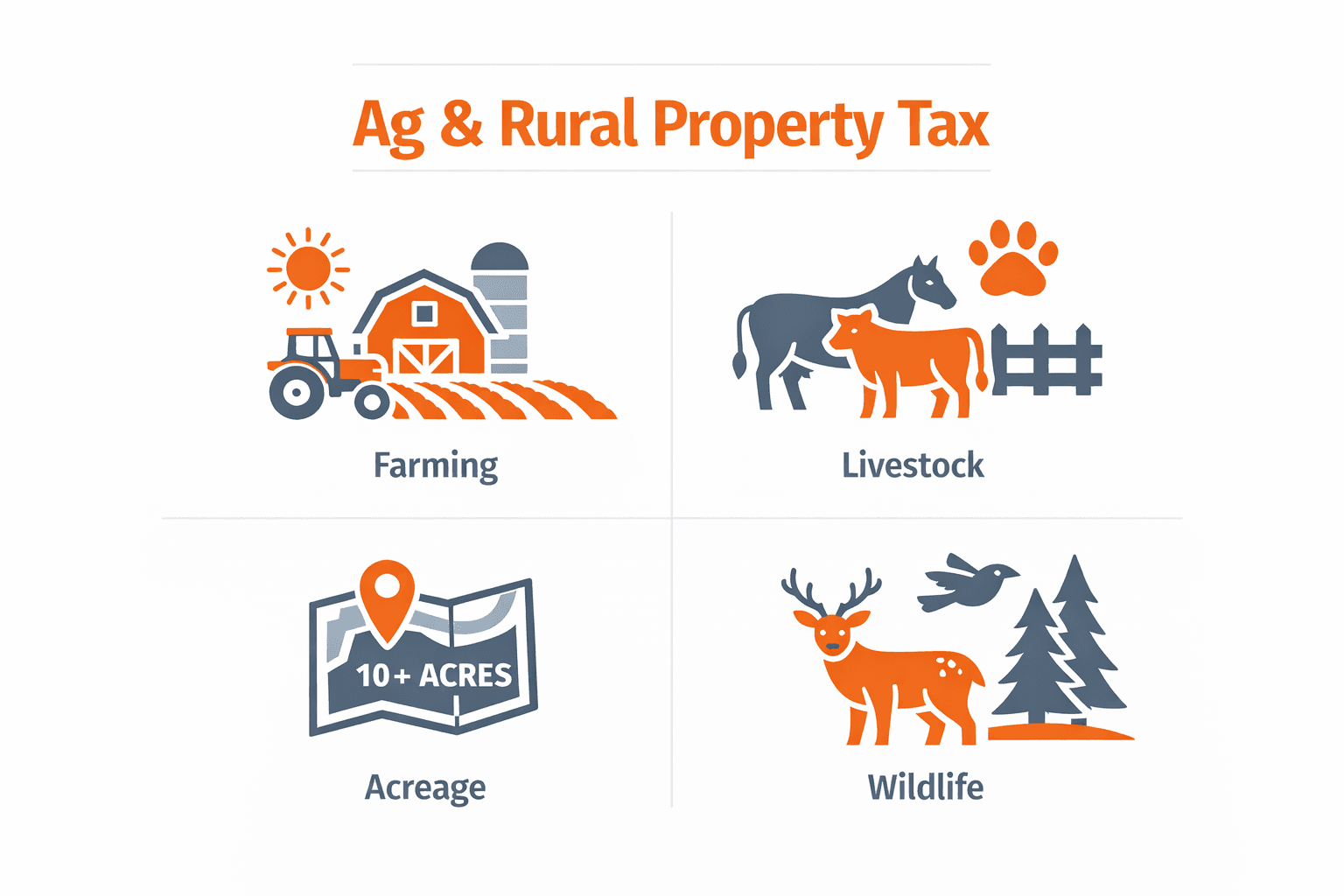
- Cattle ranching and livestock grazing (cattle, horses, goats, sheep)
- Crop production (hay, corn, wheat, cotton, vegetables)
- Beekeeping
- Horticulture (nurseries, orchards)
- Aquaculture (fish farming)
- Dairy farming
- Wildlife management (with a qualifying plan - more on this below)
- Timber production (primarily East Texas)
Simply owning rural land is not enough. The land must be actively managed for agricultural production.
2. Five of the Past Seven Years
The land must have been devoted principally to agricultural use for at least five of the preceding seven years. This is the history requirement - you can't buy vacant land and immediately qualify. There needs to be a demonstrated track record of agricultural use.
3. Degree of Intensity
Your agricultural operation must be carried out at a level of intensity that is typical for the area. This is where it gets county-specific.
Each appraisal district in Texas sets its own intensity standards based on local conditions - soil types, climate, rainfall, and the types of agriculture common in the region. What qualifies as sufficient intensity in lush East Texas is very different from what's expected in arid West Texas.
Common intensity standards include:
- Cattle: 1 animal unit per 3–7 acres depending on pasture quality and county
- Goats/sheep: 6–7 animals per animal unit
- Hay production: Active cutting and baling at intervals consistent with local practice
- Beekeeping: Minimum 6 hives on at least 5 acres (up to 20 acres)
Your appraisal district publishes its intensity guidelines - check with them before assuming your operation qualifies.
4. Minimum Acreage
There is no statewide minimum acreage written into the Tax Code, but most counties enforce their own minimums:
| Typical Range | Notes |
|---|---|
| 10–15 acres | Most common minimum for standard agricultural use |
| 5 acres | Minimum for beekeeping in many counties |
| 20+ acres | Some counties with poorer soil or arid conditions |
Some counties, like Travis County, focus more on animal units (minimum 4 animal units regardless of acreage) than on a hard acreage number. Others, like Bandera County, set minimums at 20 acres or more due to local soil conditions.
The only way to know your county's requirements is to contact your county appraisal district directly.
How Many Acres Do You Need for an Ag Exemption in Texas?
This is one of the most common questions landowners ask. The honest answer: it depends on your county and what type of agriculture you're doing.
Small Acreage Options
If you have fewer than 10 acres, your options are more limited but not zero:
-
Beekeeping is the most popular small-acreage ag qualification. Texas law allows beekeeping ag appraisal on 5 to 20 acres. You typically need at least 6 hives for the first 5 acres, with additional hives required as acreage increases. Requirements vary by county.
-
Intensive horticulture (nurseries, orchards, market gardens) may qualify on smaller tracts in some counties if the operation meets local intensity standards.
-
Hay production on 10+ acres is a common path in many Central Texas counties.
If your property is under 5 acres, qualifying for ag appraisal is very difficult in most counties.
How to Apply for an Ag Exemption in Texas
Step 1: Confirm Eligibility With Your Appraisal District
Before filing, contact your county appraisal district to understand local intensity standards, minimum acreage, and what documentation they require. Each county has its own guidelines.
Step 2: File Form 50-129
Submit Form 50-129 (Application for 1-d-1 (Open-Space) Agricultural Use Appraisal) to your county appraisal district. This is filed with the local CAD office, not with the Texas Comptroller.
Step 3: Meet the Deadline
The deadline to file is April 30 of the tax year for which you're requesting the special appraisal. Late applications filed before the appraisal review board approves the records may still be accepted, but you'll face a 10% penalty on the tax difference.
Step 4: Provide Supporting Documentation
Be prepared to provide:
- Description of agricultural activities on the property
- Number and type of livestock, or crop/production details
- Length of time the land has been in agricultural use
- Any lease agreements if the land is used by a tenant farmer or rancher
- Photos of the property showing active agricultural use
Step 5: Maintain the Exemption
Once approved, you generally don't need to reapply annually under 1-d-1 (unlike 1-d, which requires annual filing). However, the chief appraiser can request a new application at any time if there's reason to believe the agricultural use has changed. You must continue to meet intensity standards every year.
Wildlife Management Exemption: An Alternative to Traditional Ag
If you currently have an agricultural appraisal and want to shift away from active farming or ranching, you can convert to a wildlife management valuation - and keep the same tax benefits.
How It Works
Texas voters approved wildlife management as a qualifying agricultural use in 1995 (Proposition 11). Instead of running cattle or growing crops, you manage the land to sustain breeding, migrating, or wintering populations of native Texas wildlife.
The property tax impact is revenue neutral - your taxes don't change when you switch from traditional ag to wildlife management. You're still taxed on productivity value, not market value.
Requirements
-
The land must already have an ag appraisal. You cannot go directly from market value to wildlife management. The land must first qualify under 1-d-1 agricultural use.
-
You must implement a wildlife management plan and submit it to your county appraisal district along with your application.
-
You must perform at least three of seven qualifying practices each year:
- Habitat control (brush management, prescribed burns, native grass restoration)
- Erosion control
- Predator management
- Providing supplemental water sources
- Providing supplemental food (food plots, feeders)
- Providing supplemental shelter (brush piles, nesting boxes)
- Conducting wildlife census counts
-
Annual reporting is required. You must submit a report by April 30 each year detailing what management activities you performed.
Who Is It For?
Wildlife management is popular with:
- Landowners who want to stop running livestock but keep their ag valuation
- Small acreage owners - there is no minimum acreage requirement for wildlife management as long as the tract hasn't been reduced in size since the prior tax year
- Recreational landowners who want to maintain habitat for deer, quail, songbirds, or other native species
- Absentee owners who can't maintain active farming operations but can implement a management plan
Species You Can Manage For
You can manage for a wide range of native Texas wildlife - not just game species. Songbirds, small mammals (rabbits, squirrels), raptors, and pollinators all qualify. Managing for fish does not qualify as wildlife management, though it may qualify as aquaculture under traditional ag.
Rollback Taxes: The Cost of Losing Your Ag Exemption
Rollback taxes are the single biggest financial risk for landowners with agricultural appraisal. If your land's use changes from agricultural to non-agricultural, the county will recapture the tax difference for prior years.
How Rollback Taxes Work
When ag status is removed, the appraisal district calculates what your property taxes would have been at full market value for each year in the rollback period, subtracts what you actually paid under the ag valuation, and bills you the difference - plus 7% annual interest.
Rollback Period
- 1-d-1 (open-space) appraisal: Rollback covers the previous five years (changed from three years under recent law)
- 1-d appraisal: Rollback covers the previous three years
How Much Can Rollback Taxes Cost?
The amount depends on the gap between your land's market value and its agricultural value. The bigger the gap, the bigger the rollback.
Example: A 25-acre tract near a growing suburb has a market value of $750,000 but an agricultural value of $5,000. At a combined tax rate of 2.5%, the annual tax difference is about $18,625. Over a five-year rollback period plus 7% interest per year, the total rollback tax bill could exceed $100,000.
For large tracts in high-growth areas near Austin, DFW, Houston, or San Antonio, rollback tax exposure can reach hundreds of thousands of dollars.
What Triggers Rollback Taxes?
- Changing the land's use from agricultural to non-agricultural (building a commercial development, subdividing for residential lots)
- Voluntarily reducing agricultural intensity below the required standards
- Failing to file required annual reports (for wildlife management)
What Doesn't Trigger Rollback Taxes?
- Selling the land to a new owner who continues agricultural use - a sale alone does not trigger rollback under 1-d-1
- Building a homestead on the property, as long as you maintain the home as your residence for five years
- Condemnation or forced sale for public use
- Transferring to a charitable organization
- Reduced intensity due to drought, fire, or flood - factors outside the owner's control
Partial Development
If you're developing only a portion of your land, you can maintain ag status on the undeveloped portion. For example, if you develop 30 acres of a 90-acre tract, you can keep the ag appraisal on the remaining 60 acres. Only the converted portion triggers rollback taxes.
Timber Exemptions in East Texas
East Texas landowners can also qualify for a timber productivity appraisal under Texas Tax Code Section 23.72. This works similarly to agricultural appraisal - the land is taxed on its capacity to produce timber rather than its market value.
Qualifying requirements include:
- The land must be used principally for producing timber or forest products for commercial sale
- The land must have been in timber use for at least five of the preceding seven years
- The operation must meet local intensity standards set by the appraisal district
- Applications are filed on Form 50-129 (same form as ag appraisal)
Timber appraisal carries the same rollback tax provisions as agricultural appraisal. If the land's use changes, you'll owe rollback taxes for the prior five years plus interest.
Protesting Your Agricultural Valuation
Even with an ag exemption, the appraisal district still determines both the market value and the productivity value of your land. If either is set too high, you can protest.
When to Protest
- The district overestimates your land's productivity value (assigns a higher per-acre productivity rate than the land actually supports)
- The district overestimates market value, which matters if you ever lose ag status (rollback taxes are based on market value)
- The district incorrectly classifies your land type or soil quality
- Your ag application was denied and you believe you meet the requirements
How to Protest
File a Notice of Protest (Form 50-132) by May 15 or 30 days after receiving your appraisal notice, whichever is later. Bring evidence of your land's actual productivity - stocking rates, crop yields, lease rates - and any errors in the district's classification of your land.
Protect Your Ag Exemption and Your Tax Bill
Agricultural appraisal is one of the most powerful property tax tools available to Texas landowners, but it requires active management - both of the land and of the paperwork. Missing a deadline, letting intensity drop, or changing use without understanding the rollback consequences can cost you far more than the taxes you saved.
Whether you're applying for the first time, converting to wildlife management, or protesting a productivity value that's too high, contact Ballard Property Tax Protest to make sure your agricultural land is properly valued and protected.