Tax Assessment vs Property Tax: What's the Difference?
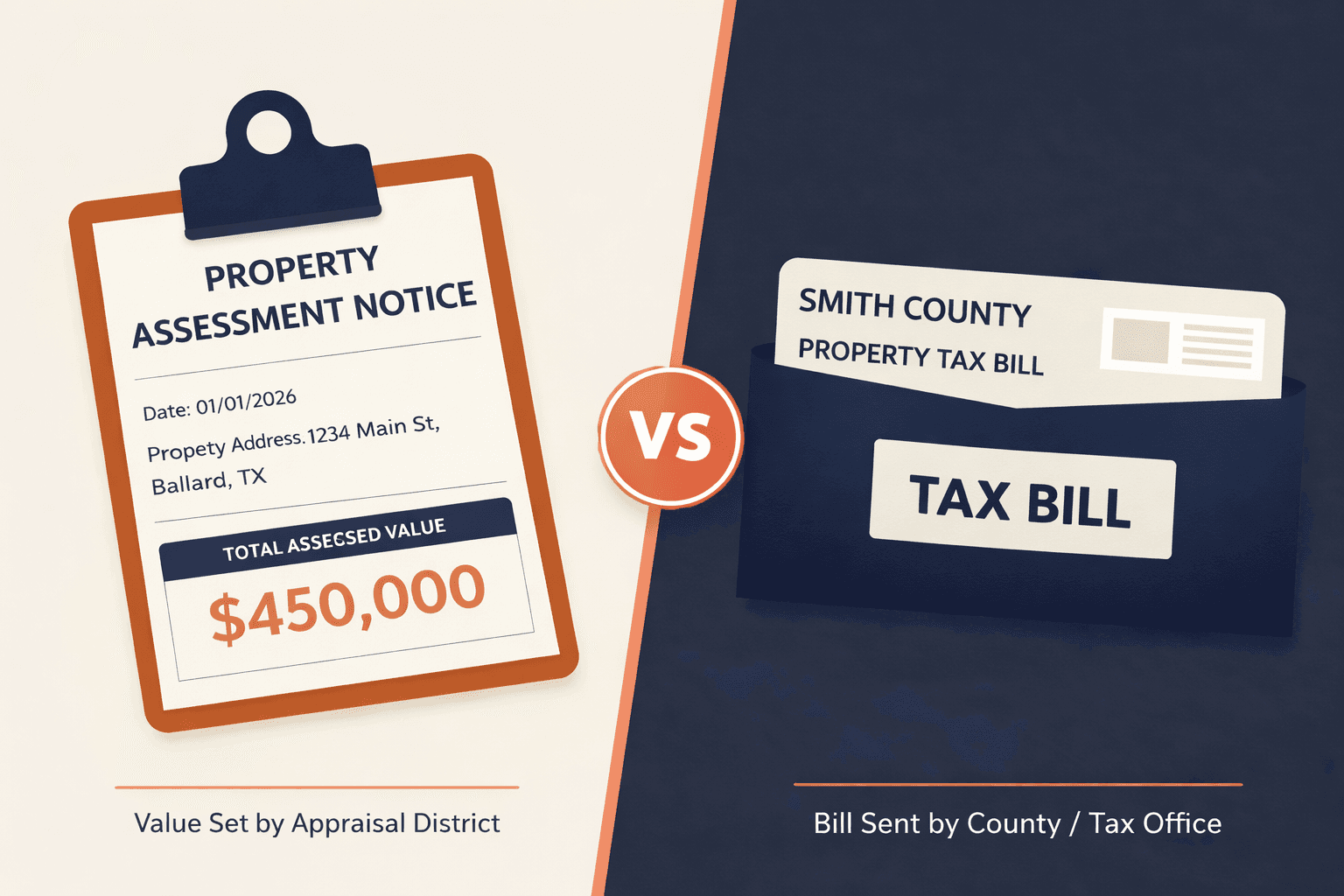
A tax assessment is the value your county places on your property. Property tax is the dollar amount you owe based on that assessment. The assessment determines how much you pay - the tax is the bill itself.
| Tax Assessment | Property Tax | |
|---|---|---|
| What it is | A value assigned to your property | A bill you pay to local governments |
| Who determines it | County appraisal district | Taxing entities (schools, city, county) |
| What you can challenge | Yes - file a protest | Not directly - set by elected officials |
| When it happens | Annually (as of January 1) | Billed in October, due January 31 |
| How to lower it | Protest your appraised value | Lower your assessment or vote on tax rates |
Understanding this distinction matters because you can directly lower your tax assessment through a protest, which automatically reduces your property tax bill. You cannot protest the tax rate itself.
What Is a Property Tax Assessment?
A property tax assessment is the process by which your county appraisal district determines the value of your property for tax purposes. In Texas, every county has a Central Appraisal District (CAD) responsible for valuing all taxable property within its borders as of January 1 each year.
The assessment process involves several values:
Market Value (Appraised Value)
Your county's estimate of what your property would sell for on the open market. This is determined through mass appraisal - computer models that estimate values for thousands of properties at once based on public records, sales data, and property characteristics.
Mass appraisal cannot account for individual property conditions like deferred maintenance, foundation issues, or outdated interiors. This is why county appraisals frequently overvalue individual homes.
Assessed Value
For homestead properties, your assessed value is your appraised value after the 10% homestead cap is applied. Under Texas law, your homestead's assessed value cannot increase by more than 10% per year, even if market values jump more than that.
Taxable Value
Your assessed value minus any exemptions you qualify for (homestead, over-65, disabled veteran, etc.). This is the final number your tax bill is calculated from.
For a detailed breakdown of how these values relate to each other, see our guide to market value vs appraised value in Texas.
What Are Property Taxes?
Property taxes are the actual dollar amounts you owe to local taxing entities based on your property's taxable value. They are calculated with a simple formula:
Property Tax = Taxable Value × Tax Rate
In Texas, your property tax bill is the sum of taxes from multiple overlapping taxing entities, each with its own tax rate:
- School districts - Typically the largest portion (40-50% of your bill)
- County government - Funds county services, roads, courts
- City/municipality - If you live within city limits
- Special districts - Hospital districts, community colleges, MUDs, emergency services districts
Each entity sets its own tax rate annually based on its budget needs. Your total tax rate is the combined rate of all entities that have jurisdiction over your property.
When Are Property Taxes Due?
In Texas, property tax bills are mailed in October and are due by January 31 of the following year. If you have a mortgage with escrow, your lender pays on your behalf from funds collected monthly.
For a full timeline, see our Texas property tax calendar.
Key Differences: Assessment vs Property Tax
Here's a more detailed comparison:
| Tax Assessment | Property Tax | |
|---|---|---|
| Definition | The valuation process that determines your property's worth for tax purposes | The financial obligation you owe based on that valuation |
| Controlled by | County appraisal district (CAD) | Taxing entities (school boards, city councils, county commissioners) |
| Can you challenge it? | Yes - file a protest by May 15 | No - rates are set through the budget process |
| How often it changes | Annually | Annually (rates change based on budgets and bond elections) |
| What determines it | Property characteristics, market conditions, comparable sales | Your taxable value multiplied by the combined tax rate |
| Your recourse | Protest, exemptions | Vote in elections, attend budget hearings |
Why This Distinction Matters
Many homeowners say "my property taxes went up" without understanding why. There are two possible causes:
- Your assessment went up - The county raised your appraised value. You can protest this.
- The tax rate went up - A taxing entity raised its rate (or voters approved a bond). You cannot protest this.
In most years in Texas, rising assessments are the primary driver of higher tax bills. Tax rates have actually decreased in many jurisdictions due to state-mandated school tax compression. But because property values have risen faster than rates have dropped, bills keep climbing.
How to Lower Your Property Tax Assessment
Since your assessment drives your tax bill, lowering it is the most direct way to reduce what you owe. You have two tools:
1. File a Property Tax Protest
Every Texas property owner has the right to protest their property's appraised value each year. Common grounds for protest include:
- Market value is too high - Comparable homes sold for less than your appraised value
- Unequal appraisal - Similar properties in your area are assessed lower than yours
- Property condition - Your home has issues not reflected in the appraisal (foundation problems, deferred maintenance, etc.)
- Errors - Incorrect square footage, bedroom count, or other data
The protest deadline is May 15 (or 30 days after your notice is mailed, whichever is later). Filing is free, and the county cannot raise your value as a result of your protest.
2. Apply for Exemptions
Exemptions reduce your taxable value, which directly lowers your tax bill:
- Homestead exemption - Removes up to $100,000 from school district taxes
- Over-65 exemption - Additional $10,000+ off school taxes, plus a tax freeze
- Disabled veteran exemption - $5,000 to 100% exemption depending on disability rating
Exemptions don't change your assessment - they reduce the taxable value that your bill is calculated from.
How to Lower Your Property Tax Rate
Unlike your assessment, you can't directly protest a tax rate. But you can influence rates through civic participation:
- Vote in local elections - School board members, city council, and county commissioners set tax rates
- Vote on bond elections - Bond proposals add to the debt service portion of tax rates
- Attend budget hearings - Texas law requires public hearings when taxing entities propose rate increases (truth-in-taxation process)
- Monitor the voter-approval rate - Taxing entities that exceed certain rate thresholds must hold elections for voter approval
Frequently Asked Questions
Is assessed value the same as appraised value?
Not exactly. In Texas, appraised value is the county's estimate of your property's market value. Assessed value is the appraised value after the 10% homestead cap is applied. If you have a homestead exemption and have owned your home for more than one year, your assessed value may be lower than your appraised value. For non-homestead properties, assessed value equals appraised value.
Learn more about how these values work together.
Can my assessment go down?
Yes. Your assessment can decrease if:
- Market conditions decline and the county lowers your appraised value
- You successfully protest and the Appraisal Review Board reduces your value
- Your property suffers damage that reduces its market value
In recent years, some Texas counties have seen flat or declining values in certain neighborhoods, resulting in lower assessments.
Why did my taxes go up if my assessment didn't change?
This happens when a tax rate increases while your assessment stays the same. Common causes include voter-approved bond elections, budget increases by taxing entities, or changes in the state's school funding formulas. Remember: your tax bill = assessment × rate. Either factor going up raises your bill.
Can the county raise my assessment if I protest?
No. Under Texas law, the Appraisal Review Board cannot increase your value solely because you filed a protest. The worst possible outcome is that your value stays the same.
What's the difference between a tax assessment and a tax appraisal?
In Texas, these terms are often used interchangeably in casual conversation. Technically, an appraisal is the process of estimating market value, while an assessment refers to the value used for tax purposes (after any caps or adjustments). Your county appraisal district performs the appraisal, which results in an assessed value.
Get Help Lowering Your Assessment
If your property tax assessment seems too high, Ballard Property Tax Protest can help. We file your protest, gather comparable sales evidence, and represent you at hearings - and you only pay if we successfully reduce your value.
No reduction, no fee.