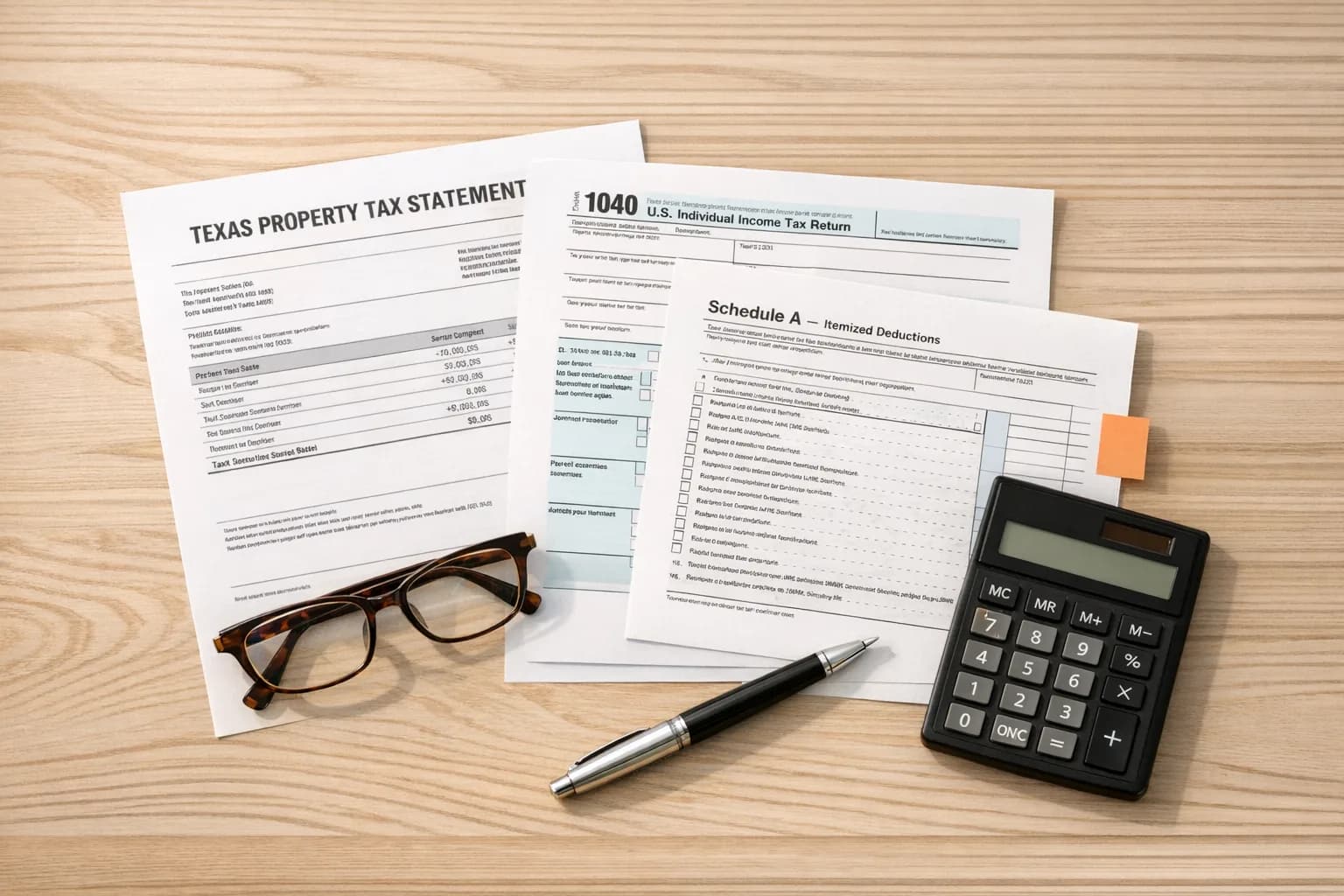
Yes, property taxes are tax deductible in Texas. You can deduct the property taxes you pay on your primary residence, second homes, and vacant land as an itemized deduction on your federal income tax return.
Since Texas has no state income tax, property taxes are usually the only SALT (state and local tax) deduction available to Texas homeowners. That makes this deduction particularly important for Texans.
Here is everything you need to know about claiming the deduction, the new SALT cap, and when it makes sense to itemize.
The SALT Deduction Cap: What Changed in 2026
The SALT deduction cap has been one of the most debated provisions in federal tax law since 2017. Here is where things stand now.
The original cap (2018-2025)
The Tax Cuts and Jobs Act of 2017 capped the total SALT deduction at $10,000 per return ($5,000 for married filing separately). This cap combined all state and local taxes - income tax, sales tax, and property taxes - into a single limit.
For many Texas homeowners, this was a significant hit. A homeowner with a $400,000 home and a 2.0% effective tax rate was paying $8,000 in property taxes alone, leaving very little room under the cap for other deductions.
The new cap (2026-2029)
The One Big Beautiful Bill Act raised the SALT cap substantially:
| Tax Year | SALT Cap | Married Filing Separately |
|---|---|---|
| 2026 | $40,400 | $20,200 |
| 2027 | $40,800 | $20,400 |
| 2028 | $41,200 | $20,600 |
| 2029 | $41,600 | $20,800 |
| 2030+ | $10,000 | $5,000 |
The cap increases by 1% annually through 2029, then reverts to $10,000 in 2030 unless Congress acts again.
Income phase-out
There is a phase-out for higher earners. If your modified adjusted gross income exceeds $505,000 in 2026, your SALT deduction is reduced by 30 cents for every dollar over that threshold. The deduction cannot fall below $10,000 regardless of income.
What this means for Texas homeowners
Under the old $10,000 cap, most Texas homeowners who paid more than $10,000 in property taxes got no additional benefit from itemizing SALT. The new $40,400 cap means nearly every Texas homeowner can now deduct their full property tax bill. Even homeowners in Travis County, where a median-value home generates over $10,000 in annual property taxes, will fall well under the new limit.
Itemizing vs. Standard Deduction
You can only deduct property taxes if you itemize your deductions on Schedule A. The alternative is taking the standard deduction, which requires no documentation and is available to everyone.
2026 standard deduction amounts
| Filing Status | Standard Deduction |
|---|---|
| Single | $16,100 |
| Married filing jointly | $32,200 |
| Head of household | $24,150 |
| Married filing separately | $16,100 |
Taxpayers age 65 or older get an additional $2,050 (single) or $1,650 (married) on top of these amounts.
When itemizing makes sense
Itemizing is worth it when your total itemized deductions exceed the standard deduction. For most homeowners, the three biggest itemized deductions are:
- Property taxes (Schedule A, Line 5b)
- Mortgage interest (Schedule A, Line 8a)
- Charitable contributions (Schedule A, Line 12)
Example: A married couple in Dallas County with a $350,000 home might have:
- Property taxes: $7,777
- Mortgage interest: $14,000
- Charitable giving: $3,000
- Total: $24,777
In this case, the standard deduction of $32,200 is higher, so they would take the standard deduction. But add a second property, higher mortgage interest, or significant charitable contributions, and itemizing could win out.
With the new $40,400 SALT cap, the math has shifted. Homeowners who were previously capped at $10,000 in SALT deductions now have room to deduct their full property tax bill, which may push more filers over the standard deduction threshold.
What Property Taxes Are Deductible
Not everything that shows up on your tax bill qualifies for the deduction.
Deductible
- Property taxes on your primary residence
- Property taxes on a second home or vacation property
- Property taxes on vacant land you own
- County, city, school district, and special district taxes assessed uniformly on all property
Not deductible on Schedule A
- Special assessments for local improvements (sidewalks, sewers) that increase your property value
- Transfer taxes or recording fees
- HOA fees or dues
- Trash collection fees or utility charges billed separately
- Property taxes on rental or business property (these are deducted as business expenses on Schedule E or Schedule C instead)
Texas-Specific Considerations
Texas homeowners have a unique tax situation that affects how the property tax deduction works in practice.
No state income tax
Since Texas has no state income tax, property taxes are the primary - and usually only - SALT deduction available. In states like California or New York, homeowners must split their $40,400 SALT cap between state income tax and property taxes. Texas homeowners can use the entire cap for property taxes.
High property tax rates
Texas has some of the highest property tax rates in the country. Across the 18 counties we serve, combined rates range from 1.57% in Rockwall County to 2.27% in Bexar County. For a complete comparison, see our Texas Property Tax Rates by County guide.
At these rates, a homeowner with a $400,000 property is paying roughly $6,300 to $9,080 per year in property taxes depending on location. Under the old $10,000 cap, this was the entire SALT deduction for most Texans. Under the new $40,400 cap, there is substantial room to spare.
Homestead exemption does not affect your deduction
The homestead exemption reduces the taxable value of your property for purposes of calculating your tax bill. But your federal deduction is based on the actual dollar amount you pay, not your assessed value. If your exemption reduces your bill from $8,000 to $6,500, you deduct $6,500.
How to Claim the Deduction
Step 1: Gather your records
You need documentation of the property taxes you actually paid during the tax year. The best sources are:
- Your county tax assessor-collector's payment receipt
- Your annual mortgage statement (Form 1098) if you pay through escrow
- Your county's online tax payment portal
Step 2: File Schedule A
Report your real estate taxes on Schedule A (Form 1040), Line 5b. This is the line specifically for state and local real estate taxes.
If you also want to deduct state and local sales taxes (instead of income taxes, since Texas has no income tax), that goes on Line 5a. Your total SALT deduction on Line 5e is subject to the $40,400 cap.
Step 3: Compare to the standard deduction
Your tax software or preparer will compare your total itemized deductions to the standard deduction and use whichever is higher. If itemizing does not beat the standard deduction, you do not need Schedule A at all.
Rental and Business Property
Property taxes on rental properties and business-use properties are handled differently and are not subject to the SALT cap.
- Rental property: Deduct property taxes as an expense on Schedule E. This reduces your rental income and is not limited by the SALT cap.
- Business property: Deduct on Schedule C (sole proprietors) or the appropriate business return. Also not subject to the SALT cap.
- Mixed use: If you use part of your home for business (home office), you can allocate a portion of your property taxes to the business deduction and the remainder to Schedule A.
Lower Your Tax Bill Before You Deduct It
The federal deduction helps, but it only offsets a fraction of what you pay. If you are paying $8,000 in property taxes and you are in the 22% tax bracket, the deduction saves you about $1,760 in federal taxes. You are still paying the other $6,240.
The more direct way to save is to lower the tax bill itself. Every Texas homeowner has the right to protest their property's appraised value. A successful protest reduces your assessed value, which reduces your actual tax bill dollar for dollar.
At Ballard Property Tax Protest, we handle everything from filing to representation at the hearing. You only pay if we save you money.
The protest deadline is May 15, 2026. Start your protest today.