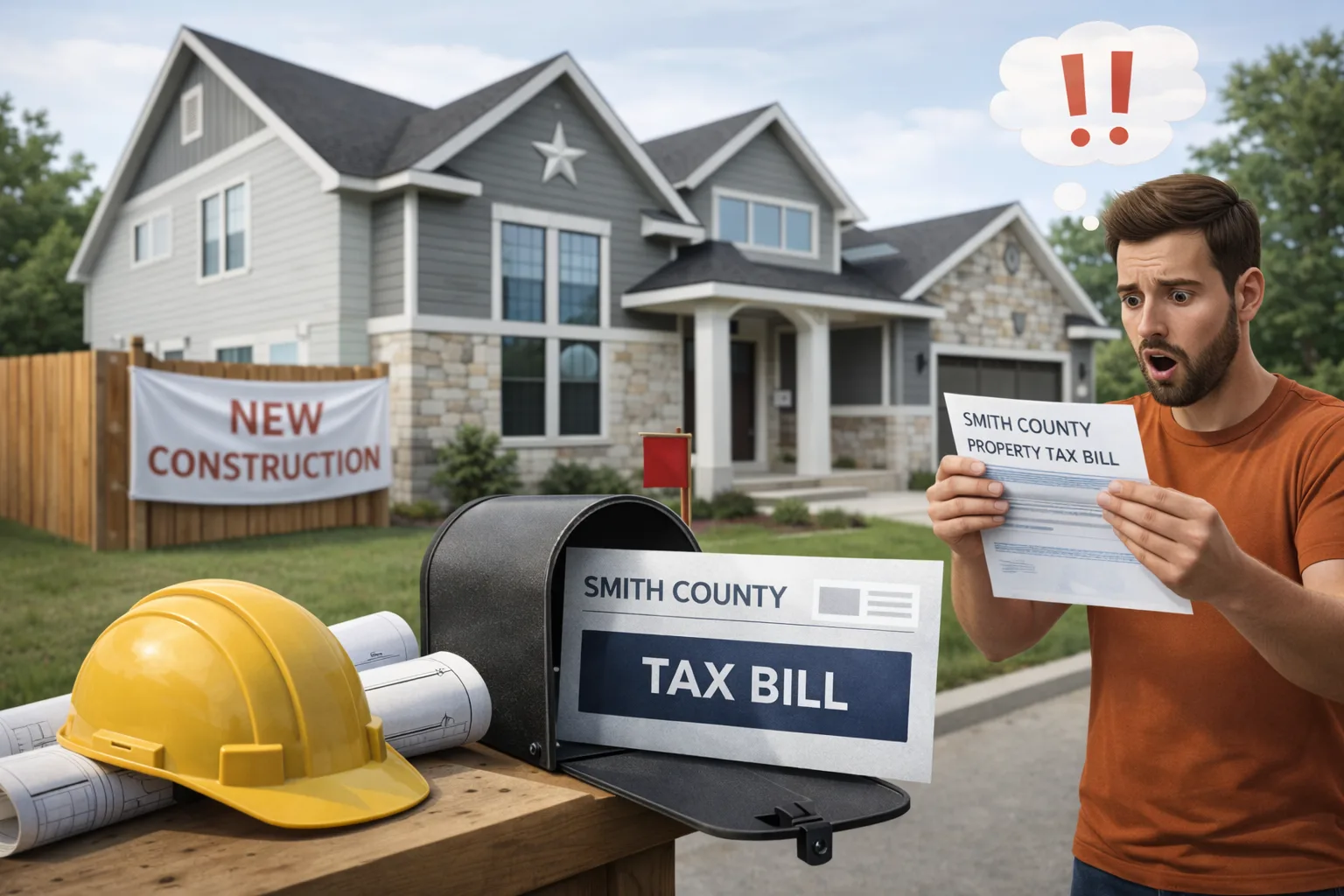
Property Taxes on New Construction in Texas: What First-Time Builders and Buyers Need to Know
Texas is one of the fastest-growing states in the country for new home construction. Subdivisions are going up across the DFW metroplex, Houston, Austin, San Antonio, and beyond. But many buyers who close on a brand-new home are caught off guard when the property tax bills start arriving - especially in year two.
If you're buying or building a new construction home, understanding how the appraisal district values your property from day one can save you thousands of dollars and help you avoid some common and costly surprises.
How New Construction Is Assessed in Texas
Every property in Texas is assessed based on its condition as of January 1 of each tax year. That snapshot date is the key to understanding why new construction taxes work the way they do.
During Construction: You Pay Taxes on the Land
If your home is still being built on January 1, you'll owe property taxes for that year based on the land value plus whatever percentage of the home is complete as of that date.
For example, if your finished home will be worth $450,000 and the structure is roughly 40% complete on January 1, the appraisal district may assess the improvement at around $180,000 plus the land value. If construction hasn't started yet, you'll only pay taxes on the vacant lot.
This is why many new construction buyers are pleasantly surprised by their first tax bill - it's artificially low because it only reflects a partially built (or unbuilt) home.
After Completion: The First Full Assessment
Once the home is complete, the appraisal district will assess it at full market value the following January 1. This is where the math changes dramatically.
If you closed on a $450,000 new build in June, your first January 1 assessment will reflect the completed home at or near that purchase price. In many cases, the district will use your closing price as a baseline for the appraised value - which means little room for argument that the value is wrong unless you have evidence to the contrary.
Why Year Two Brings Sticker Shock
The most common complaint from new construction homeowners is the second-year tax bill. Here's why it's so much higher:
Your First Bill Was Partial
If you bought in mid-2025 and your first tax bill arrived in late 2025, it was based on the January 1, 2025 assessment - which may have reflected an incomplete home or vacant land. That bill was a fraction of what the home will actually cost to tax.
The Full Value Hits in Year Two
The January 1, 2026 assessment now reflects the completed home at full market value. No more partial construction discount. The taxable value may be two to three times higher than the first year.
No Homestead Cap Yet
Here's the part that catches most people: the 10% homestead appraisal cap doesn't kick in until the year after you first receive the homestead exemption. That means your first full-value assessment is uncapped - the appraisal district can set it at whatever they believe the market value is.
If you didn't file for homestead exemption right away, the cap is delayed even further. The protection only begins once the exemption is in place and has been active for a full tax year.
Escrow Adjustments Amplify the Surprise
If your mortgage includes an escrow account, your lender estimates property taxes based on the first (lower) bill. When the full assessment comes in, your lender recalculates and adjusts your monthly payment - sometimes by several hundred dollars - to cover the shortfall. Some homeowners also receive a lump-sum escrow shortage bill on top of the higher monthly payment.
What the Appraisal District Looks at for New Construction
Appraisal districts use a combination of methods to value new homes:
Cost Approach
For brand-new builds, the cost approach is the most common valuation method. The district estimates what it would cost to build your home today - land, materials, labor, permits - and that becomes the assessed value. Since there's no depreciation on a new home, there's no deduction for age or wear.
The risk here is that the district's cost estimates may not match what you actually paid to build, or they may overestimate finish quality, square footage, or features.
Comparable Sales
If other new homes in your subdivision have already sold, the district may use those closing prices as comps for your home. In a brand-new development with limited sales history, the district may pull comps from neighboring subdivisions or different builders - which may not reflect your home's actual value.
Your Purchase Price
In Texas, appraisal districts can access MLS data, deed records, and closing documents. Your purchase price is not legally binding on the appraisal, but it heavily influences the initial assessment. If you paid $475,000, expect the district to start there.
How to Protest Property Taxes on a New Build
You absolutely can - and often should - protest the appraised value of a new construction home. Many new builds are overvalued by the appraisal district, especially in the first full assessment year. Here's how to build a strong case.
Check for Errors First
Start with the basics. The appraisal district relies on building permits and construction records rather than physical inspections for most new homes. Errors are common:
- Square footage listed incorrectly (garage counted as living space, incorrect floor plan)
- Lot size wrong in the records
- Features that don't exist (pool, extra garage bay, finished attic listed when there is none)
- Construction quality overstated (standard finishes classified as premium)
A single square footage error of a few hundred feet can inflate the appraised value by tens of thousands of dollars.
Use Adjusted Comparable Sales
Even in a new subdivision with limited sales, you can build a comp case:
- Use sales from the same builder and floor plan if available - these are the strongest comps
- Look at homes in the same subdivision or adjacent neighborhoods built in the same time frame
- Adjust for differences in square footage, lot size, upgrades, and features
- If your home has fewer upgrades than comparable sales, make sure your comps reflect that
Leverage the Cost Approach in Your Favor
If the appraisal district used the cost approach and overestimated construction costs, you can counter with:
- Your actual construction contract showing what you paid to build
- Builder pricing sheets for your floor plan and options
- Evidence that the district's cost-per-square-foot estimate exceeds actual builder costs in the area
Use the Unequal Appraisal Argument
This is especially useful in new subdivisions. If your home is appraised at $475,000 but similar homes on the same street - same builder, same floor plan, same year - are appraised at $430,000 to $450,000, you have a strong equity argument even if you can't prove market value is lower.
Pull the appraisal district's records for comparable homes in your subdivision and compare. Inconsistencies across identical or near-identical homes are common in new developments.
Document Everything From Day One
If you're building a custom home or buying pre-construction, start documenting early:
- Construction timeline photos showing the state of the home on or near January 1
- Closing documents with the actual purchase price
- Builder contracts and upgrade receipts showing exactly what you paid for
- Punch list items and defects noted at closing that affect the home's condition
Filing Your Homestead Exemption: Don't Wait
The single most important thing you can do after closing on a new home is file for your homestead exemption immediately. Here's why:
- The homestead exemption removes $100,000 of your home's value from school district taxes (as of the 2023 Proposition 4 increase)
- The 10% appraisal cap only starts the year after the exemption is granted
- Every year you delay filing means another year without the cap protecting you from large value increases
You can file with your county appraisal district online, by mail, or in person. Most counties now accept applications through their website.
Builder vs. Buyer: Who Pays Property Taxes?
During construction, the builder or developer typically pays property taxes on the land (and any partial improvements) until the home closes. At closing, taxes are prorated between the builder and buyer based on the closing date.
If you close in July, the builder owes taxes for January through June, and you owe July through December. This proration is handled at the closing table and reflected on your settlement statement.
One thing to watch: if the builder was paying taxes based on a land-only assessment and the home is now complete, the full-value tax bill arrives later in the year - and it's your responsibility. The prorated amount at closing may not have accounted for the completed home's value.
When to Protest and When to Wait
Protest If:
- The appraised value exceeds your actual purchase price
- The district has incorrect property details (square footage, features, construction quality)
- Comparable homes in your subdivision are appraised lower than yours
- Your home had construction defects or unfinished items at the January 1 assessment date
- The district's cost approach estimate significantly exceeds actual construction costs
Consider Waiting If:
- You just closed and the first partial-year assessment is low - there's no benefit to protesting a value that's already below market
- Your homestead exemption hasn't been applied yet - file for that first, then protest the following year's full assessment with the cap in place
A Timeline for New Construction Property Taxes
| When | What Happens |
|---|---|
| During construction | Builder pays taxes on land + partial improvements |
| At closing | Taxes prorated between builder and buyer |
| January 1 after closing | First full assessment of completed home |
| April | Appraisal notice mailed with new value |
| May 15 | Deadline to file a protest |
| October-January | Tax bills mailed; payment due by January 31 |
| Year after homestead filed | 10% cap begins protecting against future increases |
Don't Let Sticker Shock Catch You Off Guard
New construction homeowners in Texas face a unique set of property tax challenges - from the partial first-year assessment to the uncapped full-value jump in year two. Understanding how the system works puts you in a position to act early, file your exemptions on time, and protest when the numbers don't add up.
If you're building or buying new in Texas, contact Ballard Property Tax Protest to make sure your first full assessment is fair from the start.