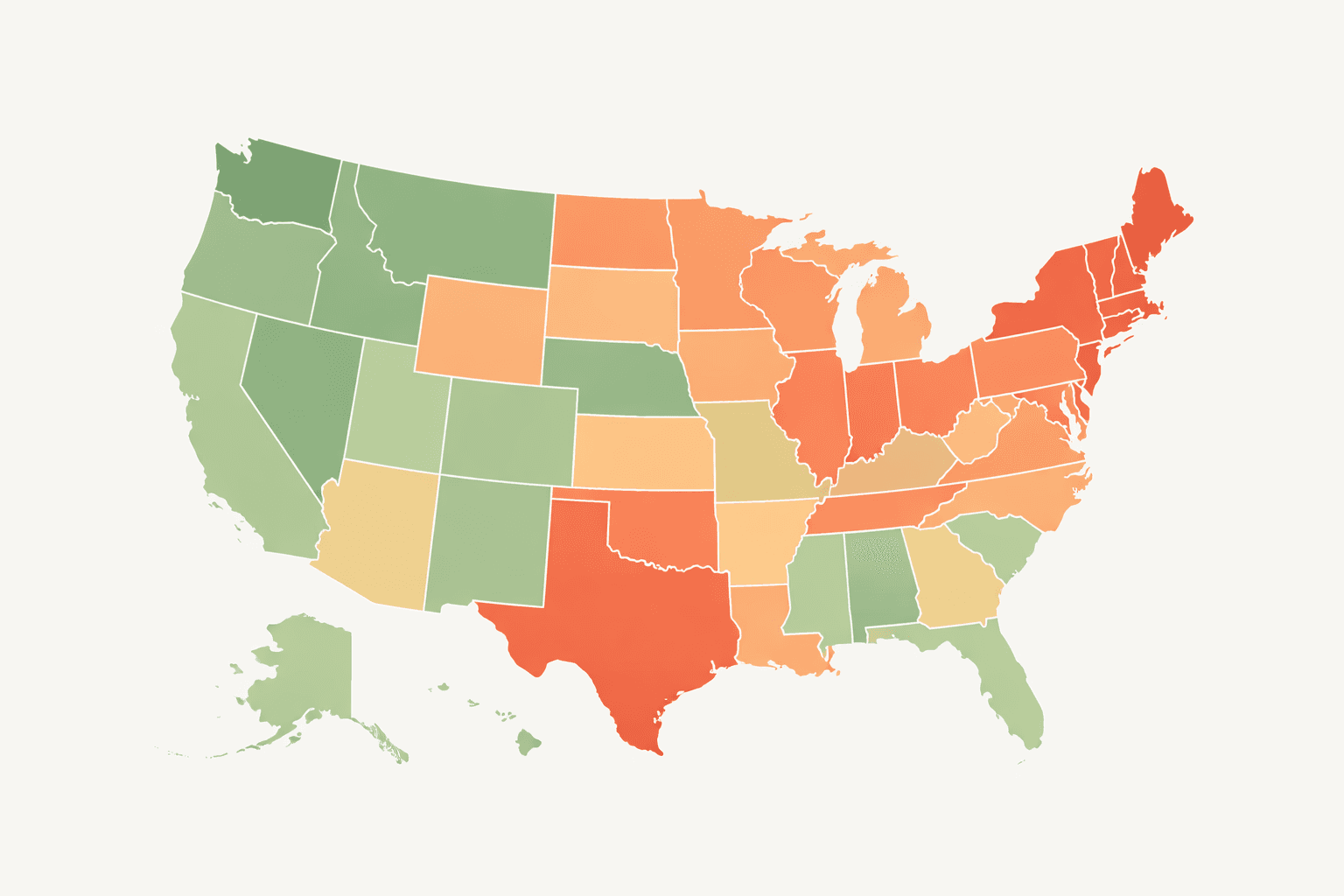
Which States Have No Property Tax?
The short answer: none. All 50 states authorize local governments to levy property taxes on real estate. No state has eliminated them entirely.
But effective rates vary enormously - from 0.27% in Hawaii to over 2.2% in New Jersey. Where you live determines whether property taxes are a minor line item or the largest bill you pay after your mortgage.
This guide breaks down which states have the lowest (and highest) property tax rates, explains why zero-percent property tax doesn't exist, and shows where Texas falls in the national picture.
Key Takeaways
- No state has 0% property tax - every state relies on property taxes for local government revenue
- Hawaii has the lowest effective rate (0.27%), but high home values mean you still pay $2,385/year
- West Virginia and Alabama have the lowest annual tax bills in dollar terms (under $900/year)
- Texas ranks 7th highest nationally with an effective rate around 1.47–1.60%
- Texas homeowners can offset higher rates through homestead exemptions and annual protests
States With the Lowest Property Taxes
These 12 states have the lowest effective property tax rates in the country, based on 2024 American Community Survey data:
| Rank | State | Eff. Rate | Median Annual Tax | Median Home Value | Income Tax? |
|---|---|---|---|---|---|
| 1 | Hawaii | 0.27% | $2,385 | $875,900 | Yes (up to 11%) |
| 2 | Alabama | 0.38% | $895 | $233,300 | Yes (up to 5%) |
| 3 | Idaho | 0.43% | $1,912 | $446,400 | Yes (5.3% flat) |
| 4 | Arizona | 0.43% | $1,828 | $426,000 | Yes (2.5% flat) |
| 5 | South Carolina | 0.45% | $1,337 | $299,500 | Yes (up to 6%) |
| 6 | Tennessee | 0.45% | $1,488 | $332,600 | No |
| 7 | Nevada | 0.47% | $2,143 | $455,500 | No |
| 8 | Delaware | 0.47% | $1,750 | $371,600 | Yes (up to 6.6%) |
| 9 | Utah | 0.49% | $2,648 | $545,200 | Yes (4.5% flat) |
| 10 | Colorado | 0.49% | $2,828 | $574,600 | Yes (4.4% flat) |
| 11 | West Virginia | 0.52% | $881 | $170,800 | Yes (up to 4.82%) |
| 12 | Louisiana | 0.55% | $897 | $163,100 | Yes (3% flat) |
A few things stand out:
Low rate doesn't always mean a low bill. Hawaii's 0.27% rate is the nation's lowest, but median home values near $876,000 push the annual bill to $2,385. Colorado and Utah have sub-0.5% rates but annual bills above $2,600 because of high home values.
The cheapest states in dollar terms are in the South. West Virginia ($881/year), Alabama ($895/year), and Louisiana ($897/year) combine low rates with low home values, making them the least expensive states for property taxes in absolute terms.
Only two low-tax states also skip income tax. Tennessee (0.45%) and Nevada (0.47%) are the only states in the top 12 that charge neither income tax nor high property taxes. That makes them attractive for people looking to minimize their total state tax burden.
States With the Highest Property Taxes
On the other end of the spectrum, these states tax property owners the hardest:
| Rank | State | Eff. Rate | Median Annual Tax | Income Tax? |
|---|---|---|---|---|
| 1 | New Jersey | 2.23% | $9,541 | Yes (up to 10.75%) |
| 2 | Illinois | 2.07% | $5,399 | Yes (4.95% flat) |
| 3 | Connecticut | 1.92% | $6,573 | Yes (up to 6.99%) |
| 4 | New Hampshire | 1.66% | $6,707 | No broad income tax |
| 5 | Vermont | 1.90% | $5,026 | Yes (up to 8.75%) |
| 6 | Nebraska | 1.38% | $3,500 | Yes (up to 5.84%) |
| 7 | Texas | 1.47–1.60% | $4,232 | No |
New Jersey homeowners pay a median of $9,541 per year - more than 10x what homeowners pay in West Virginia. And New Jersey has a state income tax on top of that.
New Hampshire is the cautionary tale for "no income tax" states: without income or sales tax, the state leans almost entirely on property taxes, pushing the effective rate to 1.66% and median bills to $6,707.
How Texas Compares
| Metric | Texas | National Median |
|---|---|---|
| Effective property tax rate | 1.47–1.60% | 0.89–0.99% |
| National ranking | 7th highest | - |
| Median annual property tax | $4,232 | $3,119 |
| Median home value | $283,800 | $332,700 |
| State income tax | None | - |
Texas has the 7th-highest effective property tax rate in the country. The state average is roughly 50–75% above the national median.
Why? Because Texas is one of nine states with no personal income tax. That missing revenue has to come from somewhere, and property taxes carry most of the load. School districts alone account for about 55% of the average Texas property tax bill. Cities, counties, and special districts (MUDs, hospital districts, community colleges) make up the rest. For a full breakdown, see our guide on how Texas property taxes work.
The No-Income-Tax Tradeoff
Texas's approach creates clear winners and losers:
High earners benefit the most. A household earning $500,000 in California would pay over $55,000 in state income tax. In Texas, that's $0. Even with a $10,000 property tax bill, the savings are enormous.
Middle-income homeowners roughly break even. A household earning $75,000 with a $300,000 home in Texas pays around $4,500–$5,000 in property taxes. In a state with a 5% income tax and a 0.5% property tax rate, they'd pay $3,750 in income tax plus $1,500 in property tax ($5,250 total) - roughly a wash.
Retirees on fixed incomes should plan carefully. Property taxes rise with home values and don't shrink when your income drops. Income taxes, by contrast, fall naturally in retirement. States like Tennessee (no income tax, 0.45% property tax rate) offer the best of both worlds for retirees.
Why No State Has Eliminated Property Taxes
Property taxes persist everywhere because they solve problems that other taxes can't:
Schools depend on them. About 45% of public K-12 education funding comes from local governments, and roughly 80% of that local share comes from property taxes. Eliminating property taxes would require states to find hundreds of billions in replacement revenue for schools alone.
The revenue is stable. Unlike income and sales taxes, which plummet during recessions, property tax revenue stays relatively flat because it's based on assessed values rather than current economic activity.
The tax base can't move. A homeowner can't relocate their house across county lines to dodge property taxes the way a business can relocate to avoid income taxes. That makes property taxes harder to avoid and more reliable for governments.
The replacement math doesn't work. In some states, close to 40% of all state and local revenue comes from property taxes. Replacing that with higher sales or income taxes would require dramatic rate increases that voters reject. North Dakota voted down full property tax elimination in 2012. Pennsylvania's proposal failed in 2016.
Local control matters. Property taxes let cities, counties, and school districts set their own funding levels. Eliminating them would centralize budget decisions at the state level - politically unpopular on both sides of the aisle.
How Texas Homeowners Can Lower Their Property Tax Burden
Texas's rate may be high, but the state gives homeowners real tools to fight back.
File Your Homestead Exemption
If the property is your primary residence, a homestead exemption removes $140,000 from your taxable value for school district taxes. Many cities and counties offer additional exemptions on top of that. It's free to file and there's no reason not to.
Protest Your Assessed Value Every Year
Every Texas property owner has the right to protest their appraised value annually. If your county appraisal district set your value too high, you're paying too much - and your value cannot go up as a result of filing a protest.
Strong protest evidence includes:
- Recent sales of comparable homes that sold for less than your assessed value
- Photos of property damage, deferred maintenance, or negative features
- An independent appraisal showing a lower market value
- Unequal appraisal data showing similar homes valued lower than yours
Work With a Protest Firm
If you'd rather not handle it yourself, a professional protest firm does the research, pulls comps, and represents you at hearings. Most firms - including Ballard Property Tax Protest - work on contingency, meaning you only pay if they save you money.
The bottom line: Texas property taxes are higher than most states, but they're not fixed. Active homeowners who file exemptions and protest regularly can save hundreds or thousands of dollars every year.
FAQ
What state has the cheapest property tax?
Hawaii has the lowest effective rate at 0.27%. But if you're looking for the lowest annual bill in dollar terms, West Virginia ($881/year) and Alabama ($895/year) are the cheapest, combining low rates with low home values.
Does any state have 0% property tax?
No. All 50 states levy property taxes through local governments. The closest any state has come is North Dakota, which is experimenting with oil-revenue-funded tax credits that have zeroed out bills for some primary-residence homeowners. But this is a credit program, not a rate elimination - property taxes still technically exist.
Which states have no property tax and no income tax?
No state has zero property tax. But two states combine no income tax with very low property tax rates: Tennessee (0.45%) and Nevada (0.47%). Wyoming (0.57%) is another no-income-tax state with below-average property taxes. Florida, while well-known for having no income tax, has a property tax rate around 0.80% - low but not among the very lowest.
Is it better to live in a state with no income tax but higher property taxes?
It depends on your income and homeownership situation. High earners save significantly in no-income-tax states like Texas. Middle-income homeowners roughly break even compared to moderate-income-tax, low-property-tax states. Retirees should be cautious - property taxes rise with home values and don't shrink when income drops, while income taxes naturally decrease in retirement.
How can I lower my property taxes in Texas?
File a homestead exemption, protest your assessed value every year, and consider working with a property tax protest firm. These steps can reduce your bill by hundreds or thousands of dollars annually - partially closing the gap between Texas and lower-tax states.