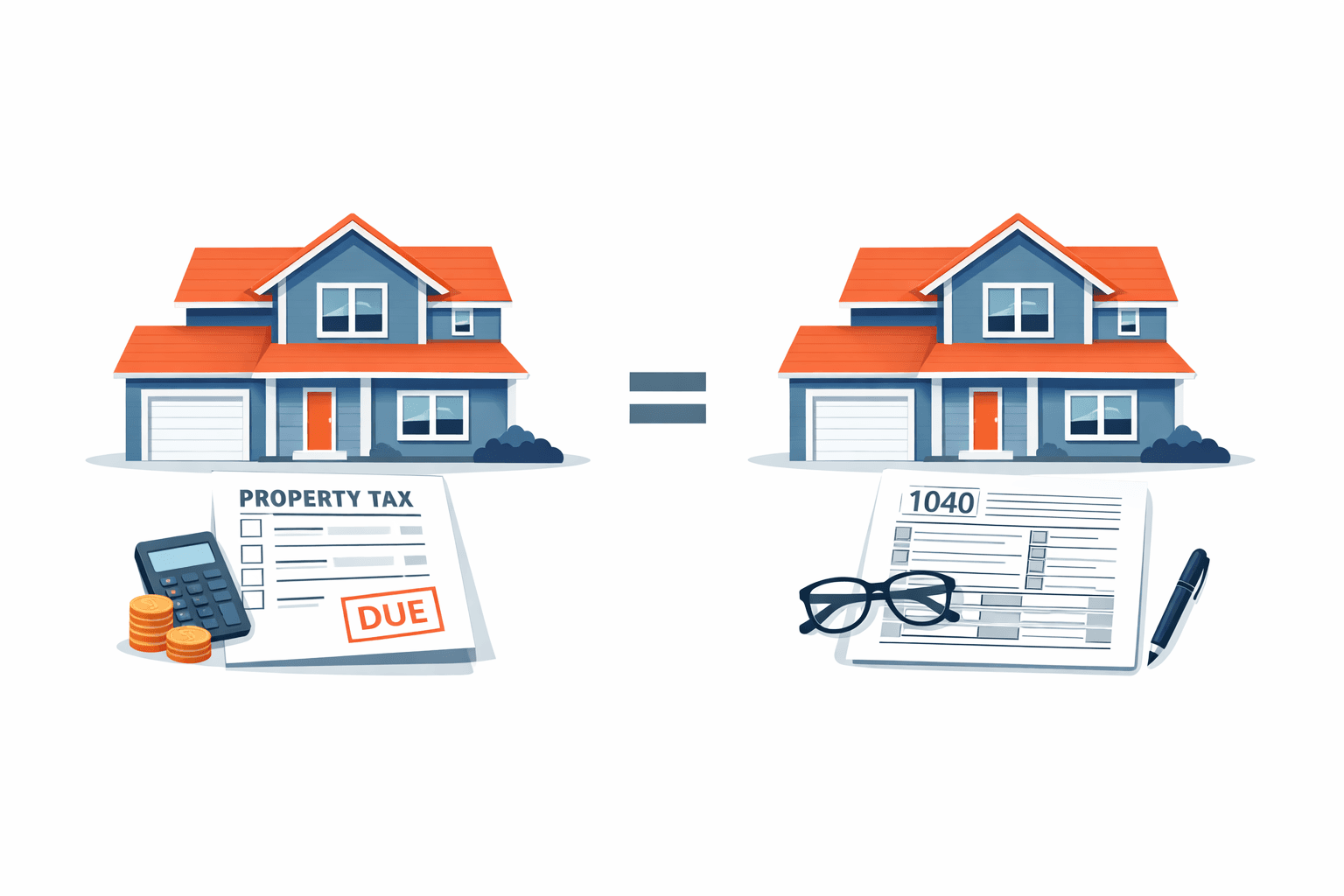
Are Real Estate Taxes the Same as Property Taxes? Key Differences Explained
Yes - for homeowners, real estate taxes and property taxes are the same thing. Both terms refer to the annual tax you pay on your home and the land it sits on. The IRS uses "real estate taxes," while most counties and homeowners say "property taxes."
- "Real estate tax" and "property tax" are interchangeable when referring to your home
- "Property tax" is technically broader - it can include taxes on personal property like vehicles or business equipment
- Texas does not tax personal property for individuals, so both terms mean exactly the same thing for Texas homeowners
- The "real estate taxes paid" line on your 1098 is the same as your property tax payment
Why the Confusion? Two Terms for the Same Tax
The confusion comes down to how different institutions label the same payment. Here's who uses which term:
| Who | Term They Use |
|---|---|
| IRS (tax returns, 1098 forms) | Real estate taxes |
| County appraisal districts | Property taxes |
| Mortgage companies | Real estate taxes (on 1098) or property taxes (in escrow statements) |
| Texas Comptroller | Property taxes |
| Most homeowners | Property taxes |
When you pay your annual tax bill to Harris County, Dallas County, or any other Texas county - that payment is both a "property tax" and a "real estate tax." The money goes to the same place regardless of what you call it.
The Technical Difference: Real Property vs Personal Property
While the terms are interchangeable for your home, there is a technical distinction worth understanding - especially during tax season.
Property tax is the broader category. It covers taxes on two types of property:
Real Property (Real Estate)
Real property includes land and anything permanently attached to it:
- Your house and any permanent structures (garage, shed, pool)
- The land your home sits on
- Commercial buildings
- Undeveloped land
Taxes on real property are called real estate taxes - this is what appears on your 1098 form and what you can deduct on your federal return.
Personal Property
Personal property includes movable assets that are not attached to land:
- Vehicles (cars, trucks, motorcycles)
- Boats and RVs
- Business equipment, inventory, and fixtures
- Aircraft
Some states tax personal property. Texas is not one of them - at least not for individuals.
What Texas Does and Doesn't Tax
Understanding what Texas taxes helps clarify why "real estate tax" and "property tax" are effectively identical for Texas homeowners.
| Property Type | Taxed in Texas? | Who Pays |
|---|---|---|
| Your home and land | Yes | All homeowners |
| Commercial real estate | Yes | Business/property owners |
| Vehicles | No | - |
| Boats and RVs | No | - |
| Household items | No | - |
| Business equipment and inventory | Yes | Businesses only |
For individual homeowners in Texas, the only property tax you pay is on your real estate. There is no separate personal property tax on your car, boat, or personal belongings.
This is different from states like Virginia, Connecticut, and Rhode Island, where homeowners pay an annual personal property tax on their vehicles in addition to their real estate taxes.
Business Personal Property Tax in Texas
While individuals don't owe personal property tax, Texas businesses do. Business personal property (BPP) includes equipment, machinery, inventory, furniture, and fixtures. Businesses must file an annual BPP rendition with their county appraisal district.
The good news: Texas has been raising the BPP exemption threshold, meaning many small businesses with limited equipment owe nothing.
How This Affects Your Tax Return
This is the most common reason people search for the difference between real estate taxes and property taxes - they're trying to file their federal return and the terminology doesn't match.
The 1098 Form
Your mortgage company sends you a Form 1098 each January. It includes a line for "real estate taxes paid" - this is the exact same amount your county collected as property taxes through your escrow account.
If you pay property taxes directly (no escrow), you'll use your county tax receipt to report the same figure. Either way, the IRS considers these "real estate taxes."
The SALT Deduction
You can deduct property taxes on your federal return if you itemize deductions. The SALT (State and Local Tax) deduction is capped at $10,000 per year ($5,000 if married filing separately).
Here's where Texas homeowners have an advantage: since Texas has no state income tax, your entire $10,000 SALT cap can go toward property tax deductions. In states with income tax, homeowners must split that cap between state income tax and property taxes.
Example: A Texas homeowner paying $8,500 in property taxes can deduct the full amount. A California homeowner paying $8,500 in property taxes and $12,000 in state income tax can only deduct $10,000 total - leaving $10,500 on the table.
What You Can Deduct
| Deductible (Real Estate Taxes) | Not Deductible |
|---|---|
| Property taxes on your primary home | HOA dues |
| Property taxes on a second home | Transfer taxes or stamps |
| Property taxes paid at closing (prorated) | Special assessments for improvements |
| Property taxes on vacant land you own | Fees for services (trash, water) |
How Property Taxes Work in Texas
Whether you call them property taxes or real estate taxes, here's how they're calculated in Texas:
Step 1: Your Property Is Appraised
Every January 1, your county's Central Appraisal District (CAD) estimates the market value of your property. This is called your appraised value. The CAD uses mass appraisal methods - computer models that estimate values based on sales data, property characteristics, and market trends.
Mass appraisal can't account for individual property conditions, which is why county values are often higher than what a home would actually sell for.
Step 2: Exemptions Reduce Your Taxable Value
If you have a homestead exemption, your taxable value is reduced. The general homestead exemption removes up to $100,000 from school district taxes and an additional amount from other taxing entities.
Other exemptions include over-65, disabled, and disabled veteran exemptions.
Step 3: Tax Rates Are Applied
Multiple taxing entities set their own rates, which are combined into your total tax rate. A typical Texas homeowner might see:
| Taxing Entity | Example Rate |
|---|---|
| School district | 1.05% |
| County | 0.35% |
| City | 0.45% |
| Hospital district | 0.15% |
| Community college | 0.10% |
| Total | 2.10% |
Step 4: Your Tax Bill Is Calculated
Property Tax = Taxable Value × Combined Tax Rate
Example: A home appraised at $400,000 with a $100,000 homestead exemption has a taxable value of $300,000. At a 2.10% combined rate, the annual property tax bill is $6,300.
For a detailed breakdown, see our guide on how Texas property taxes work.
How to Lower Your Property Taxes in Texas
Regardless of what you call them, the goal is the same - pay less. Here are the two most effective strategies:
1. Make Sure You Have All Your Exemptions
The homestead exemption alone can save hundreds or thousands per year. Many homeowners also qualify for additional exemptions they haven't applied for.
2. Protest Your Appraised Value Every Year
If your county's appraised value is higher than your home's actual market value, you have the right to protest. You can challenge the appraisal using comparable sales, property condition evidence, or unequal appraisal arguments.
The protest deadline is May 15 each year (or 30 days after your notice of appraised value is mailed, whichever is later). Filing is free, and the county cannot raise your value as a result of your protest.
Understanding the difference between your assessed value and appraised value is key to building a strong protest case.
Frequently Asked Questions
Are real estate taxes the same as property taxes on my 1098?
Yes. The "real estate taxes paid" line on your 1098 mortgage interest statement reports the same property taxes your county collected on your home. The IRS uses "real estate taxes" as the formal term, while most homeowners and counties call them "property taxes." They are the same payment - just different terminology.
What is the difference between real estate tax and property tax?
For homeowners, there is no practical difference. Both refer to the annual tax on your home and land. Technically, "property tax" is a broader term that can also include personal property taxes on vehicles, boats, or business equipment. Texas does not tax personal property for individuals, so for Texas homeowners the two terms are identical.
Does Texas have a personal property tax?
Texas does not charge personal property tax on vehicles, boats, or household items for individuals. However, Texas does tax business personal property - equipment, inventory, and fixtures owned by businesses.
Can I deduct property taxes on my federal tax return?
Yes. You can deduct property taxes (listed as "real estate taxes" by the IRS) on your federal return if you itemize. The SALT deduction cap limits your combined state and local tax deduction to $10,000 per year ($5,000 if married filing separately). Since Texas has no state income tax, your entire SALT deduction can go toward property taxes.
How are property taxes calculated in Texas?
Texas property taxes are calculated by multiplying your property's taxable value by the combined tax rate of all local taxing entities (school district, county, city, and special districts). Your taxable value is your appraised value minus any exemptions like the homestead exemption. Learn more in our guide on how Texas property taxes work.
What is a tax assessment vs a property tax?
A tax assessment is the value placed on your property by the county appraisal district. A property tax is the bill you pay based on that value. The assessment determines how much you owe - the tax is the actual payment. You can protest your assessment, but you cannot directly protest the tax rate.
Lower Your Texas Property Taxes
If your property tax bill seems too high, your appraised value may be inflated. Ballard Property Tax Protest can help. We file your protest, gather comparable sales evidence, and represent you at hearings - and you only pay if we successfully reduce your value.
No reduction, no fee.