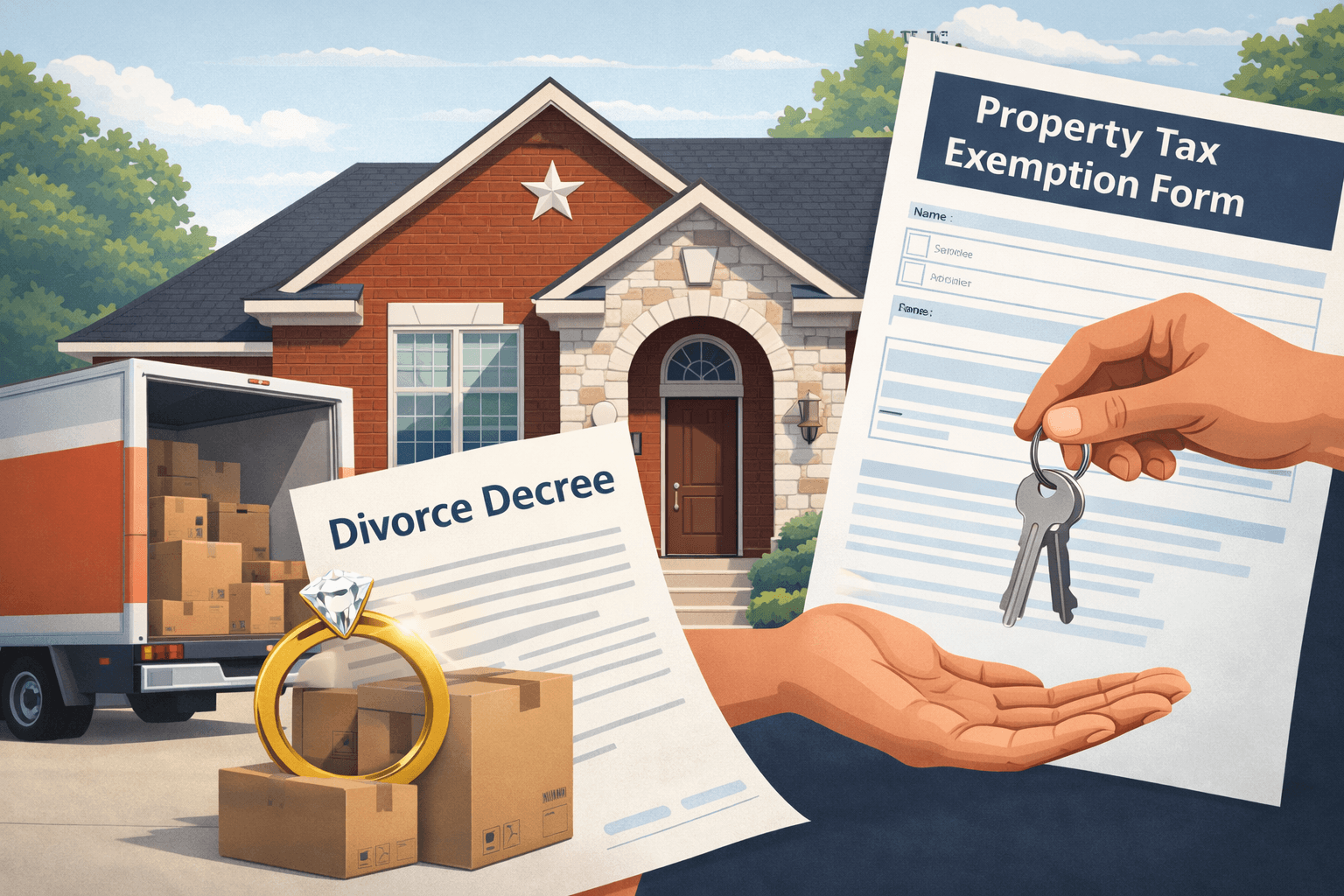
Texas Property Taxes After Divorce, Inheritance, or Moving: What Changes and What to Do
Your property tax bill in Texas doesn't just depend on what your home is worth. It depends on your homestead exemption status, your appraisal cap history, and who owns the property. All of those can change overnight when life throws a curveball.
Divorce, the death of a spouse, inheriting a family home, downsizing, or even just moving across town - each of these events can trigger significant changes to your property tax situation. And if you don't act quickly, you could lose protections that took years to build up.
Below are the most common life events that affect Texas property taxes and what to do in each situation.
Divorce and Property Taxes in Texas
Who Keeps the Homestead Exemption?
In a divorce, only the spouse who retains ownership and continues living in the home can keep the homestead exemption. The exemption doesn't automatically transfer - the spouse staying in the home must reapply with the county appraisal district in their name alone.
If neither spouse stays in the home and it's sold as part of the settlement, the homestead exemption ends at the time of sale. Any unpaid or prorated property taxes are typically settled at the closing table.
What Happens to the 10% Appraisal Cap?
This is where it gets complicated. The 10% homestead appraisal cap is tied to the homestead exemption being continuously in place. If there's a gap in coverage - for example, the exemption lapses during the divorce process and isn't reapplied for promptly - the cap can reset.
If the spouse keeping the home refiles without a gap, the cap should continue. But if ownership changes (for instance, the home is transferred entirely to one spouse who wasn't previously on the deed), the appraisal district may treat it as a new homestead and reset the cap. The appraised value could jump to full market value in a single year.
What to do: Refile for the homestead exemption as soon as the divorce is finalized and ownership is settled. Don't assume it carries over automatically.
Buyout Scenarios
If one spouse buys out the other's share of the home, the property may be reassessed depending on how the transfer is structured. An owelty of partition (a court-ordered payment to equalize property division) is one of the few exceptions that allows a lien on homestead property in Texas. If the buyout is structured as a sale, the appraisal district may use the buyout price as evidence of market value.
Property Taxes on a Second Household
The spouse who moves out and buys or rents a new home will need to file a new homestead exemption on their new primary residence. Until they do, the new property won't have homestead protection - no exemption and no 10% cap.
Inheriting a Home in Texas
The Homestead Cap Resets
When a homeowner passes away and heirs inherit the property, the previous owner's homestead exemption and 10% appraisal cap do not automatically transfer. The property will be reassessed at current market value, and any cap savings the previous owner had built up over the years are gone.
For a home that's been in the family for decades, this can mean a dramatic increase in appraised value. A home that was capped at $250,000 under the previous owner might be reassessed at $450,000 or more based on current market conditions.
Heir Property Rules (SB 1943)
Texas passed Senate Bill 1943 in 2019 to make it easier for heirs to claim homestead exemptions on inherited property. Before this law, many heirs - especially those who inherited without a formal will or deed - struggled to qualify.
Under the current rules:
- You don't need a deed in your name to claim the homestead exemption on an inherited home. An affidavit included in the exemption application (Form 50-114) is sufficient.
- If you co-own the home with other heirs (siblings, for example), you can still claim 100% of the homestead exemption as long as the home is your primary residence and you're paying the property taxes - even if the other heirs don't live there.
- You must use the home as your principal residence and have a Texas driver's license or ID matching the property address.
What to Do When You Inherit
- File for the homestead exemption immediately using Form 50-114 with your county appraisal district
- Expect a reassessment - the appraised value will likely jump to current market value
- Plan to protest the first assessment after inheritance, especially if the district overvalues the property
- The 10% cap will begin the year after your homestead exemption is granted, so the sooner you file, the sooner you're protected
When a Spouse Passes Away
General Homestead Exemption
If your spouse passes away and you continue to own and live in the home, you can maintain the homestead exemption. A surviving spouse who has a life estate or ownership interest in the property qualifies to keep the exemption in place.
The 10% appraisal cap should continue uninterrupted as long as the exemption remains active and you don't change ownership of the property.
Over-65 Exemption and Tax Ceiling
If your deceased spouse had an over-65 exemption, you may be able to keep it - and the associated tax ceiling (which freezes your school district taxes at a fixed dollar amount):
- If you are age 55 or older, you can retain the over-65 exemption and the school tax ceiling that was in place, even if you haven't turned 65 yourself
- The tax ceiling continues as long as you own and live in the home
- You can even transfer the ceiling to a new home within the same taxing unit if you move
Disabled Veteran Exemption
If your spouse had a 100% disabled veteran exemption (total property tax exemption), you can keep it as a surviving spouse if:
- You have not remarried
- The property was your residence homestead at the time of your spouse's death
- You continue to live in the home
If you later move, you can transfer the exemption to a new homestead for the same dollar amount as the former exemption.
Military and First Responder Exemptions
Surviving spouses of military members killed in the line of duty or first responders killed in the line of duty are entitled to a total property tax exemption on their homestead, as long as they have not remarried. This applies regardless of when the death occurred and can be transferred to a new homestead.
What to do: Contact your county appraisal district to confirm that all exemptions remain in place after a spouse's death. File Form 50-114 if you need to update the exemption into your name.
Moving Within Texas
Your Homestead Exemption Does Not Transfer
When you sell your home and buy a new one in Texas, you cannot transfer your homestead exemption to the new property. You must:
- Cancel the exemption on your old home (notify the appraisal district of the date you moved out)
- File a new homestead exemption application (Form 50-114) on your new home
- Update your Texas driver's license or state ID to reflect the new address - the address must match
You can file for the new homestead exemption at any time during the year (Texas removed the January 1 ownership requirement starting in 2022). The deadline to apply is April 30 for the current tax year.
The 10% Appraisal Cap Resets
This is the part that catches most people off guard. The 10% appraisal cap you built up on your old home does not carry over to your new home. The cap starts fresh the year after your new homestead exemption is granted.
That means your new home's first assessment will be at full market value with no cap protection. If you're moving from a home where the cap had been saving you tens of thousands in appraised value, the jump can be significant.
Texas does not have "portability" like Florida, where you can transfer assessed value savings to a new property. In Texas, every move means starting over on the cap.
Exception: Over-65 and Disabled Tax Ceiling Transfer
If you have an over-65 or disability exemption, you can transfer your school district tax ceiling to a new homestead. The ceiling transfers as a percentage - if you were paying 40% of the school taxes that would otherwise be owed on your old home, your new ceiling will be set at 40% of what the school taxes would be on the new home.
To transfer the ceiling within the same county, request a certificate from the appraisal district for your former home. If you're moving to a different county, the new county's appraisal district will coordinate the transfer.
Downsizing or Upsizing
Downsizing to a Smaller Home
If you're selling a larger home and buying a smaller one, keep in mind:
- You lose the appraisal cap on the old home
- The new, smaller home will be assessed at current market value
- Even though the home costs less, your effective tax rate on the new home may be higher than what you were paying on the old one after years of cap savings
This is a common surprise for retirees who downsize expecting lower taxes, only to find the new home's uncapped value produces a similar or even higher bill than their old capped value.
Upsizing to a Larger Home
Moving up to a more expensive home means starting the cap over on a higher base value. The first year will be assessed at full market value, and the 10% cap kicks in the following year. Budget accordingly for the first full tax bill.
Buying a Second Home
If you purchase a second home in Texas - a lake house, vacation property, or future retirement home - it will not qualify for the homestead exemption as long as your primary residence is elsewhere.
That means:
- No homestead exemption savings
- No 10% appraisal cap (though the temporary 20% non-homestead cap applies through 2026 for properties under $5 million)
- Higher effective tax bills compared to a primary residence of the same value
- You can still protest the appraised value every year - and you should, since there's less protection against overvaluation
If you eventually move into the second home as your primary residence, you can file for the homestead exemption at that time.
Protect Yourself: A Checklist for Life Events
After a Divorce:
- Refile homestead exemption in the retaining spouse's name
- Cancel exemption on any property you no longer own or occupy
- File new homestead exemption on any new primary residence
- Protest the first assessment if ownership changes triggered a value increase
After Inheriting a Home:
- File homestead exemption immediately (Form 50-114, affidavit is sufficient)
- Expect reassessment to current market value
- Protest the first post-inheritance appraisal
- Confirm all co-owner heirs understand that one resident heir can claim 100% exemption
After a Spouse Passes Away:
- Confirm homestead exemption remains active with the appraisal district
- Apply for surviving spouse exemptions (over-65, disabled veteran, military) if applicable
- Verify the tax ceiling is still in place for school district taxes
After Moving:
- Cancel homestead exemption on the old home
- File new homestead exemption on the new home immediately
- Update your Texas driver's license or state ID to the new address
- Request ceiling transfer if you have an over-65 or disability exemption
- Budget for the first uncapped assessment on the new home
- Protest the new home's first full-value assessment
Don't Let a Life Change Become a Tax Surprise
Major life events are stressful enough without an unexpected property tax increase on top of everything else. The key is acting quickly - filing exemptions, protesting reassessments, and understanding how the cap works (and when it resets).
If you're going through a divorce, settling an estate, or getting ready to move, contact Ballard Property Tax Protest to make sure your property tax situation is handled correctly from the start.