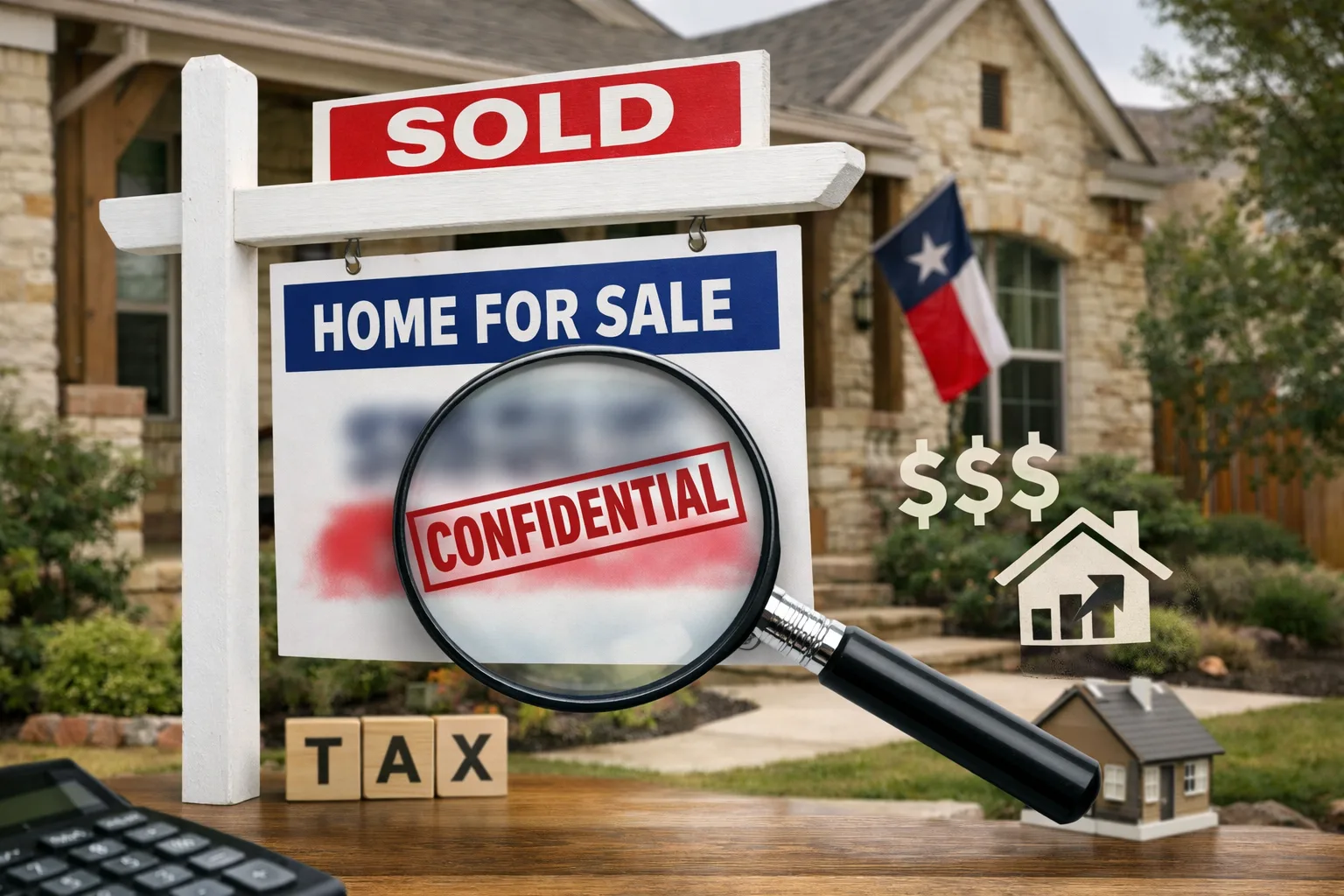
Is Texas a Non-Disclosure State?
Yes, Texas is a non-disclosure state. This means home sale prices are not part of the public record. When you buy or sell a house in Texas, the transaction price is not recorded with the county clerk or made available in public databases. This directly affects how appraisal districts value your home-and your property tax bill.
What Is a Non-Disclosure State?
A non-disclosure state is one where real estate sale prices are not publicly recorded. In these states, the deed filed with the county shows that a property changed hands, but not the price paid. This is the opposite of disclosure states like California or Florida, where anyone can look up what a home sold for.
Non-Disclosure States (2026)
There are 12 non-disclosure states in the U.S.:
| State | Notes |
|---|---|
| Alaska | No mandatory disclosure |
| Idaho | Sale prices not on public records |
| Indiana | No mandatory disclosure |
| Kansas | No mandatory disclosure |
| Louisiana | No mandatory disclosure |
| Mississippi | No mandatory disclosure |
| Missouri | No mandatory disclosure |
| Montana | No mandatory disclosure |
| New Mexico | No mandatory disclosure |
| North Dakota | No mandatory disclosure |
| Texas | No mandatory disclosure |
| Wyoming | No mandatory disclosure |
The remaining 38 states and Washington D.C. are disclosure states, where sale prices are part of the public record either through transfer tax declarations or mandatory reporting.
Disclosure vs Non-Disclosure: What's the Difference?
| Disclosure States | Non-Disclosure States (Texas) | |
|---|---|---|
| Sale price on deed | Yes, or on transfer tax form | No |
| Public can look up prices | Yes | No |
| Appraisal district access | Direct access to sale prices | Must estimate or request voluntarily |
| Comparable sales for protests | Easy to find | Harder to find without MLS access |
How Non-Disclosure Affects Texas Property Taxes
Because Texas is a non-disclosure state, your county appraisal district cannot simply look up what homes sell for when determining property values. Instead, they rely on:
- Computer-assisted mass appraisal (CAMA) models that estimate values based on property characteristics, location, and market trends. Learn more about how Texas CAMA systems work.
- Voluntary sales data submitted by real estate agents, title companies, and property owners
- MLS data purchased or obtained through agreements with real estate boards
- Income and cost approaches for certain property types
This reliance on indirect data means appraisal districts don't always have accurate sale price information. The result is that mass appraisal models can overvalue or undervalue individual properties, which directly impacts your tax bill.
Why This Often Leads to Overvaluation
Without direct access to every sale price, appraisal districts may:
- Apply broad market trends that don't reflect your specific neighborhood
- Miss condition issues or other factors that lower a home's actual value
- Use incomplete sales data that skews toward higher-priced transactions
- Fail to account for seller concessions, repairs, or other deal adjustments
This is one reason why understanding your appraised value vs. fair market value is so important in Texas.
How Non-Disclosure Affects Property Tax Protests
Texas's non-disclosure status has significant implications for the property tax protest process.
The Appraisal District May Ask for Your Sale Price
When you protest, the appraisal district may request your closing disclosure or settlement statement to verify what you paid. Here's what you need to know:
- You are not legally required to share it. Texas law does not compel homeowners to disclose their sale price.
- Sharing can help if you bought the home for less than the appraised value-your actual purchase price is strong evidence that the appraisal is too high.
- Sharing can hurt if you bought for more than the appraised value-the district may use your sale price to justify a higher valuation.
Should You Share Your Sale Price?
| Situation | Recommendation |
|---|---|
| Bought below appraised value | Share it-supports a lower appraisal |
| Bought at or near appraised value | Consider carefully; may not help |
| Bought above appraised value | Don't share-could increase your value |
| Bought in a bidding war | Don't share-inflated price doesn't reflect typical market |
| Significant seller concessions | Share with context-net price may support lower value |
How Comparable Sales Are Gathered Without Public Records
In disclosure states, finding comparable sales is straightforward-anyone can look up recent sale prices. In Texas, gathering comps requires:
- MLS access - Real estate agents and licensed professionals can access the Multiple Listing Service, which contains sale prices
- Broker price opinions - Appraisal districts may survey brokers for sales data
- Voluntary reporting - Some title companies and agents share data with appraisal districts
- Appraisal district surveys - Districts mail questionnaires to buyers asking for sale prices
- Fee appraisals - Professional appraisals commissioned for lending purposes
This data gap is one reason why comparable sales evidence is so powerful in protests-the appraisal district may not have the same data you do.
Why Non-Disclosure Makes Professional Representation Valuable
As a homeowner, you face a significant disadvantage when protesting on your own in a non-disclosure state:
- You can't easily look up what nearby homes sold for. Websites like Zillow and Redfin show estimates, but not verified sale prices in Texas.
- The appraisal district has more data than you. Districts receive voluntary sales data and MLS feeds that individual homeowners don't have access to.
- Professional protest firms have MLS access and can pull actual comparable sales to build your evidence packet.
This information asymmetry is one reason property tax protest companies are particularly valuable in Texas compared to disclosure states where anyone can look up sale prices.
Common Questions About Texas Non-Disclosure
Can I look up what my neighbor's house sold for in Texas?
Not through public records. In Texas, sale prices are not recorded on deeds or available through county clerk searches. You may find estimates on real estate websites, but these are not verified sale prices. A real estate agent with MLS access can provide actual sale prices.
Does the appraisal district know what I paid for my home?
They might, but not necessarily. Appraisal districts gather sales data through surveys, MLS feeds, and title company submissions, but participation is voluntary. If your sale price was reported through one of these channels, the district may have it on file.
Can I use non-disclosure to my advantage in a protest?
Yes. If the appraisal district doesn't know your actual sale price and has overvalued your property, you're under no obligation to correct them. However, if you have evidence that your home is worth less than the appraised value-whether from your sale price, comparable sales, or condition issues-presenting that evidence in a protest can lower your taxes.
Do other states have better property tax protest systems because of disclosure?
Not necessarily. Disclosure doesn't eliminate over-appraisal. But in disclosure states, homeowners can more easily gather comparable sales data to support their protests. In Texas, the non-disclosure system creates an information gap that makes professional help more impactful.
Reduce Your Property Taxes With Better Data
Texas's non-disclosure status means the appraisal district is working with incomplete information-and so are you if you protest on your own.
At Ballard Property Tax Protest, we have access to MLS sales data, market analysis tools, and years of experience presenting evidence to appraisal review boards across Texas. We build your protest with actual comparable sales, not estimates.
No reduction, no fee.